Category: Art

  • Artist Spotlight: Shunsaku Hayashi — Solo Show in Berlin

    Artist Spotlight: Shunsaku Hayashi — Solo Show in Berlin

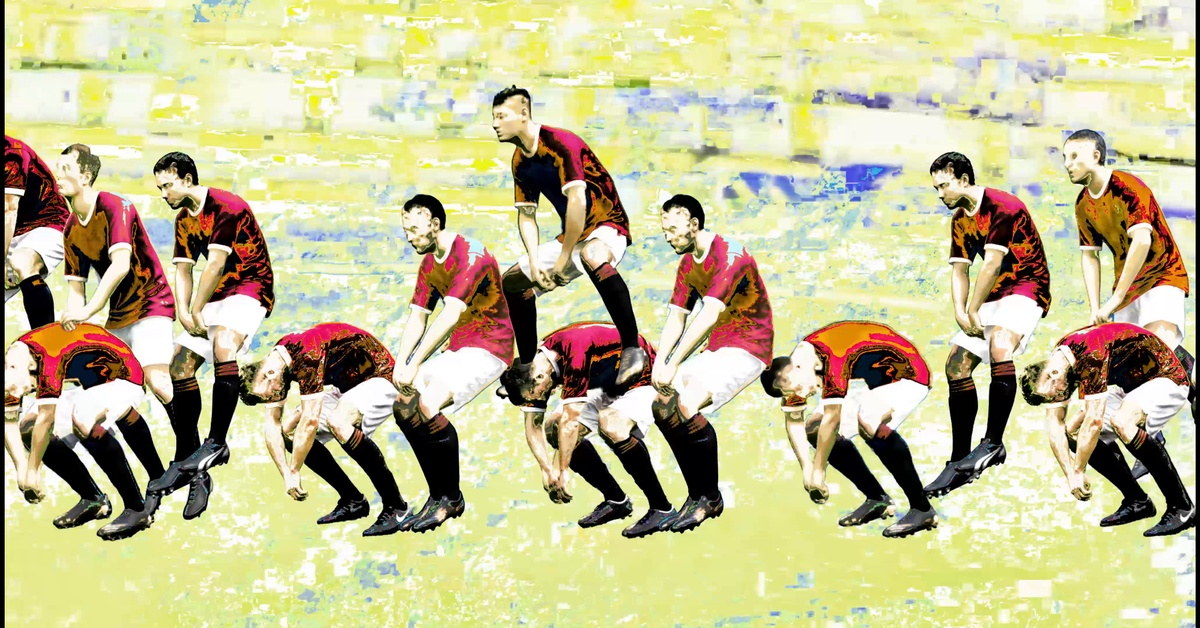
    There is a particular kind of image that refuses to sit still in the mind: a leap-frog, suspended mid-jump, caught between the roles of hero and humiliated. Japanese artist and filmmaker Shunsaku Hayashi (b. 1992, Osaka) has built an entire show around it. Hovers, currently on view in Berlin, takes the schoolyard or children’s play, and a borrowed gesture from a football video game, and stretches it into something closer to ritual: a loop of triumph and submission that Hayashi renders across both stop-motion film and five large-format paintings.

    Hayashi studied Fine Art at Goldsmiths, University of London, as part of the Japan Cultural Ministry’s Abroad Research Fellowship for emerging artists, and has since built a practice with painting and film at its core. His animated short Interstitial (2017) won the Grand Jury Prize for Animation at Slamdance, and Railment (2017) picked up the Chris Frayne Award for Best Animated Film at the Ann Arbor Film Festival. The two media inform each other at every stage of his process where the paintings in Hovers aren’t storyboards or documentation of the film; they carry their own weight, looking, like ancient frescoes or hyper modern wall paintings waiting to be excavated centuries from now.

    Art-Beats asked Hayashi about his move to Berlin, how he has experienced working in Europe compared to Japan, and how a brief moment in a football video game became the starting point for an entire body of work.

    From Osaka to Goldsmiths to Berlin
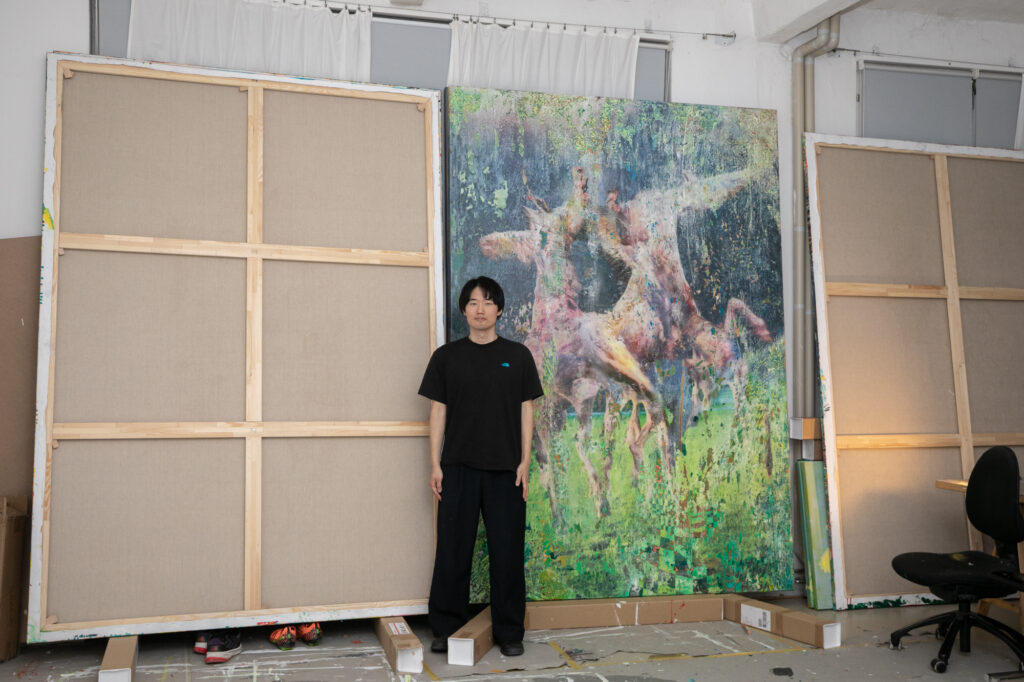
    Photo: Galya Feierman courtesy of the artist

    Hayashi’s path to Berlin was neither direct nor planned. After Goldsmiths, he returned to Japan and spent years developing his practice. Still primarily focusing on painting, but increasingly entangled with experimental film and animation, a medium he had explored since childhood. His films traveled the international festival circuit while he remained based in Japan, working on a feature-length project that would take five years to complete.

    Completing that film became a turning point. “I decided to move abroad again, create paintings and moving-image works from the ground up in a new place, and present them where they had been made,” he explains. Berlin offered that. A city where, as he puts it, something is happening almost every day, whether an exhibition, a performance, or a music event, and where encountering other people’s work sits naturally alongside making your own. He is currently an artist-in-residence at Künstlerhaus Bethanien, working in the largest studio space he has ever had.
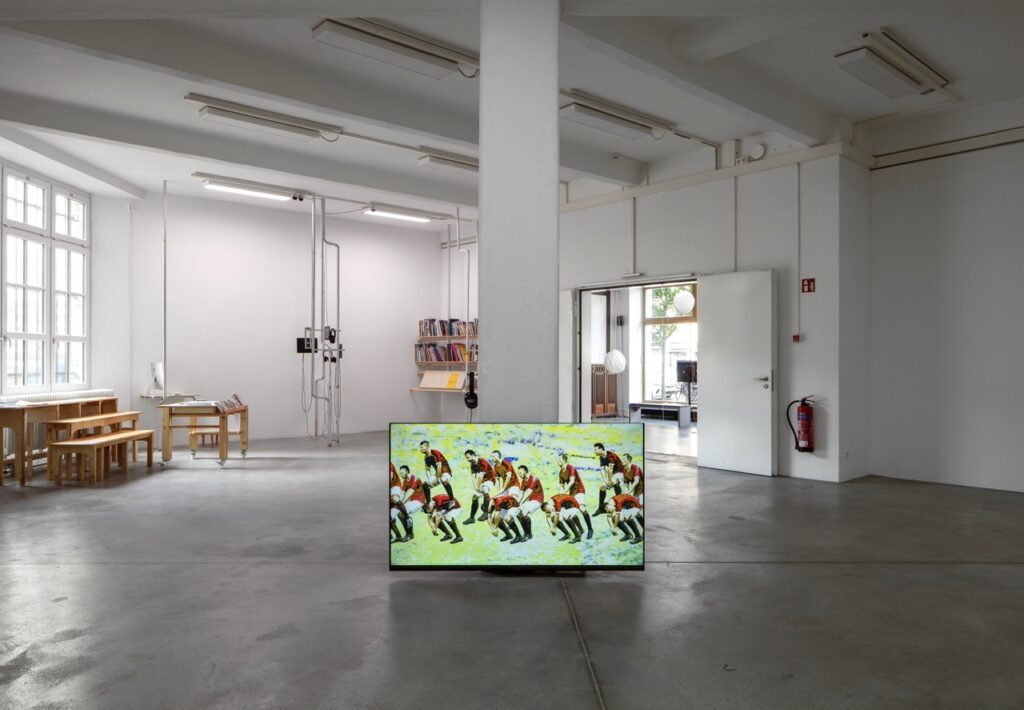
    Photo: Ludger Paffrath, courtesy of the artist

    The city hasn’t fundamentally changed how he works, he is careful to say, but it has allowed him to push a practice already in motion much further. And something has shifted emotionally. “The anxiety and sense of urgency that I carried while living in Japan suddenly began to feel much less important after I came to Berlin,” he says. Not because the problems disappeared, but because they shrank. “I now feel as though my life has begun to move forward and is gradually gaining momentum.” It is a quiet admission from someone whose work is anything but quiet, and it gives Hovers, made in this new phase, a particular quality of release.

    The Gesture That Stayed

    Several years ago, Hayashi caught a glimpse of something in a football video game: a brief goal celebration, a leap-frog, gone almost before it registered. It stayed with him. “I began to wonder what it would mean if this brief gesture continued looping indefinitely and the match never restarted,” he says. That question became the seed of the whole project.

    Some celebrations interested him more than others, but this gesture stayed with him. It carried a nostalgic echo of childhood play while also containing what he describes as an interesting conceptual structure: the roles of jumper and supporter continuously alternate, and through that repetition, the group moves forward. Neither role is fixed. Neither body is in charge.

    From there, Hayashi dug into the relationship between sport, society, and politics — reading about football in wartime Europe, Japanese baseball biographies, histories of specific clubs, and accounts of how football first arrived in Japan. What he found was a tension he recognised: the sporting body is trained and controlled in pursuit of victory, but inside that discipline, moments of play and accident keep breaking through. “Even amid seriousness, moments of humour can emerge, while something that begins as play can suddenly become serious or even violent,” he says. The leap-frog sits precisely in that unstable space. By engaging in a gesture with no direct relationship to winning, the body briefly steps outside its own prescribed logic, not free exactly, but looser for a moment.
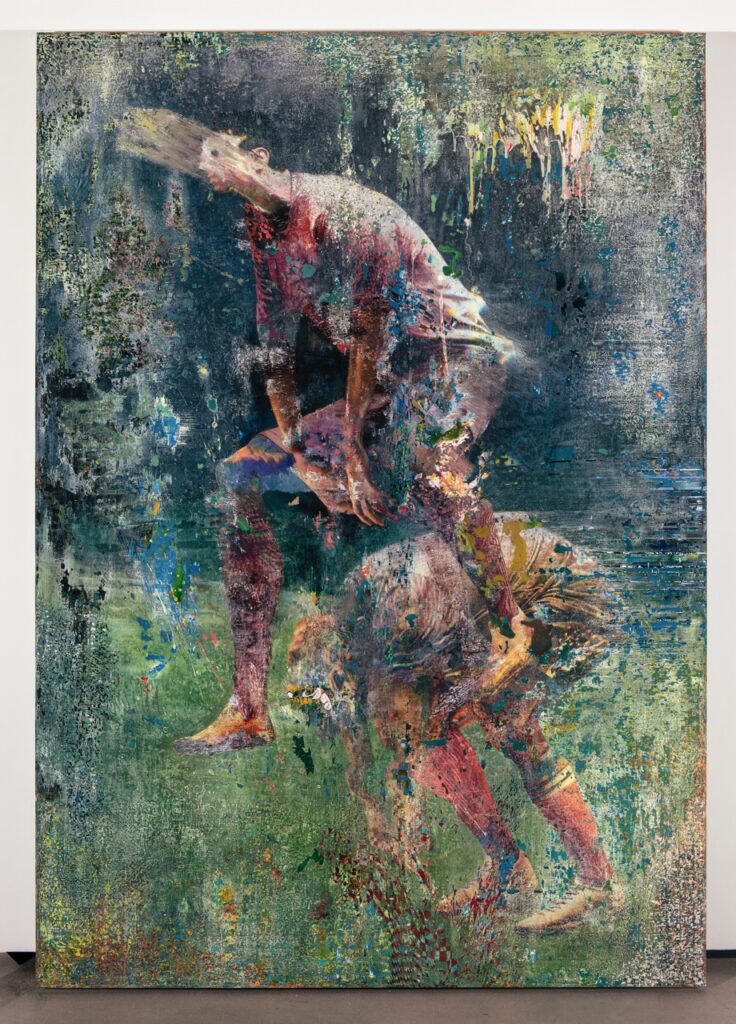
    Photo: Ludger Paffrath, courtesy of the artist

    In the exhibition, this plays out across five large-format paintings and a single-channel film. The paintings depict the individual phases of a leap-frog from right to left, grounded and overpainted in elaborate, many-layered detail. Hayashi searches within the buildup of paint for what he calls attractive concealed or coincidentally occurring formations, illusions of digital artefacts blending with complex systems of brushstrokes, glowing colours scattering against dark backgrounds. They look historicised, as though they belong to a time that hasn’t arrived yet. The film accompanies them: stop-motion animation drawn from the paintings, an oscillating electronic soundtrack, and the players leaving the stadium, the game abandoned behind them.

    Painting as Time, Film as Material

    The relationship between the two media in Hayashi’s work is not one of illustration or documentation. It is more genuinely reciprocal than that, and understanding it is key to understanding why his work holds together the way it does.

    “In my practice, painting and moving image are not made separately,” he explains. “I develop them simultaneously, moving back and forth between the two processes so that each can influence and transform the other. Sometimes I destroy what may already appear to be a finished painting in order to create a scene for the moving image. At other times, an unexpected development within a painting changes the narrative or structure of the film.” The painter and the filmmaker in him, he says, are always in dialogue.

    What draws him to stop-motion specifically is the way movement in the film leaves traces in the painting, layers of paint that carry the memory of motion, time made material. “What appears as time in the moving image becomes material in the painting.” That equation works in reverse too: the painting slows the film down, gives it mass, keeps it from floating free of the physical world.

    This has direct implications for how he thinks about digital tools and AI. He is not dismissive of them, but rather interested in digital textures, in the quality that compression and noise and missing information produce, and in the friction that occurs when analogue and digital materials meet but don’t fully merge. What doesn’t interest him is seamlessness. “I am not particularly interested in AI or digital tools when they are used simply to make everything appear seamless and smooth,” he says. “Every medium has its strengths and limitations. Its limitations can become part of what makes it distinctive.” The question he asks of any technology is not whether to accept or reject it, but what kinds of time and texture it produces, and what might become invisible in the process.

    Seeing and Not Seeing

    In our exchange, Hayashi shared something that reframes much of what comes before it. He previously underwent surgery for a retinal detachment, and the lower half of the visual field in one eye is still missing. The experience prompted a question that has run through his work ever since: what are my eyes actually seeing? Is the world I believe I am seeing really there?

    That uncertainty about perception has resurfaced across his filmography. In Interstitial, he was working with the moving spotlight theory of time, the idea that past, present, and future all exist while the present moves along the timeline like a spotlight, and built a work in which all moments coexisted on a single ten-metre canvas while appearing sequentially in the film. Earlier work like Invisions (2025) approached perception from a more personal angle, grounded in how the world appears through his own damaged, adaptive eye.

    With Hovers, he feels he has moved outward. “I have moved away from a perspective centred on myself,” he says. The exchange between jumper and supporter has shifted his attention from individual perception to the way multiple bodies connect, separate, and enable each other to move. The retinal absence that once turned his gaze inward has become, in this work, a lens trained outward — on the collective body, on the group departing the stadium, on what it might mean to move otherwise.
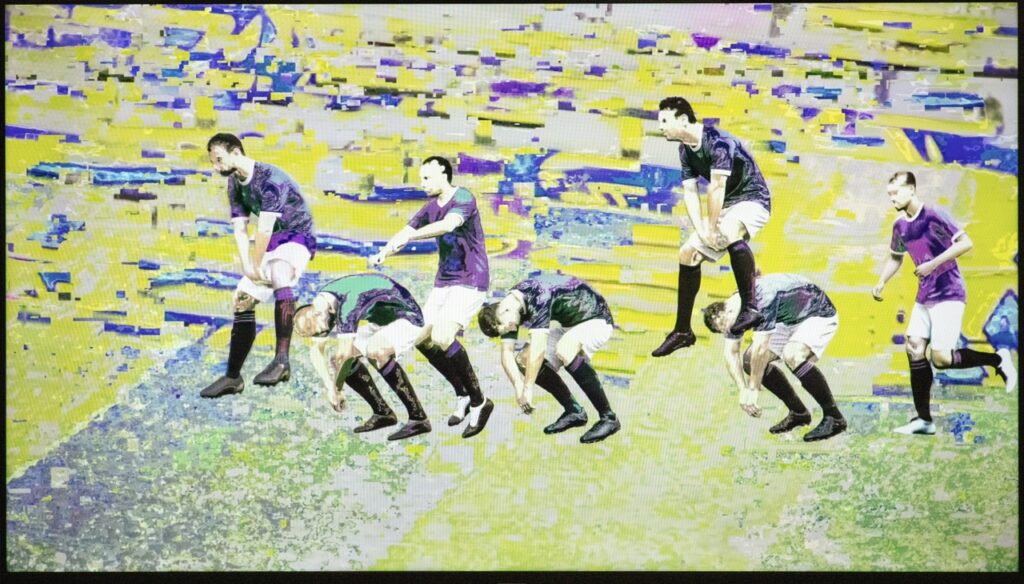
    Photo: Ludger Paffrath, courtesy of the artist

    It is a natural evolution, and it makes Hovers feel less like a standalone exhibition than a point of arrival — and of departure. Hayashi already envisions expanding the project: twelve to twenty-four paintings surrounding the viewer, a multi-channel installation in which different moving images unfold at different speeds. The leap-frog keeps looping. The roles keep reversing. The team keeps moving.

    Shunsaku Hayashi’s Hovers is on view at Künstlerhaus Bethanien, Kottbusser Straße 10, 10999 Berlin, from 12 June to 9 August 2026. Opening hours: Wednesday–Sunday, 2–7pm.
    Links

  • Art Basel 2026 and the Art of Today

    Art Basel 2026 and the Art of Today

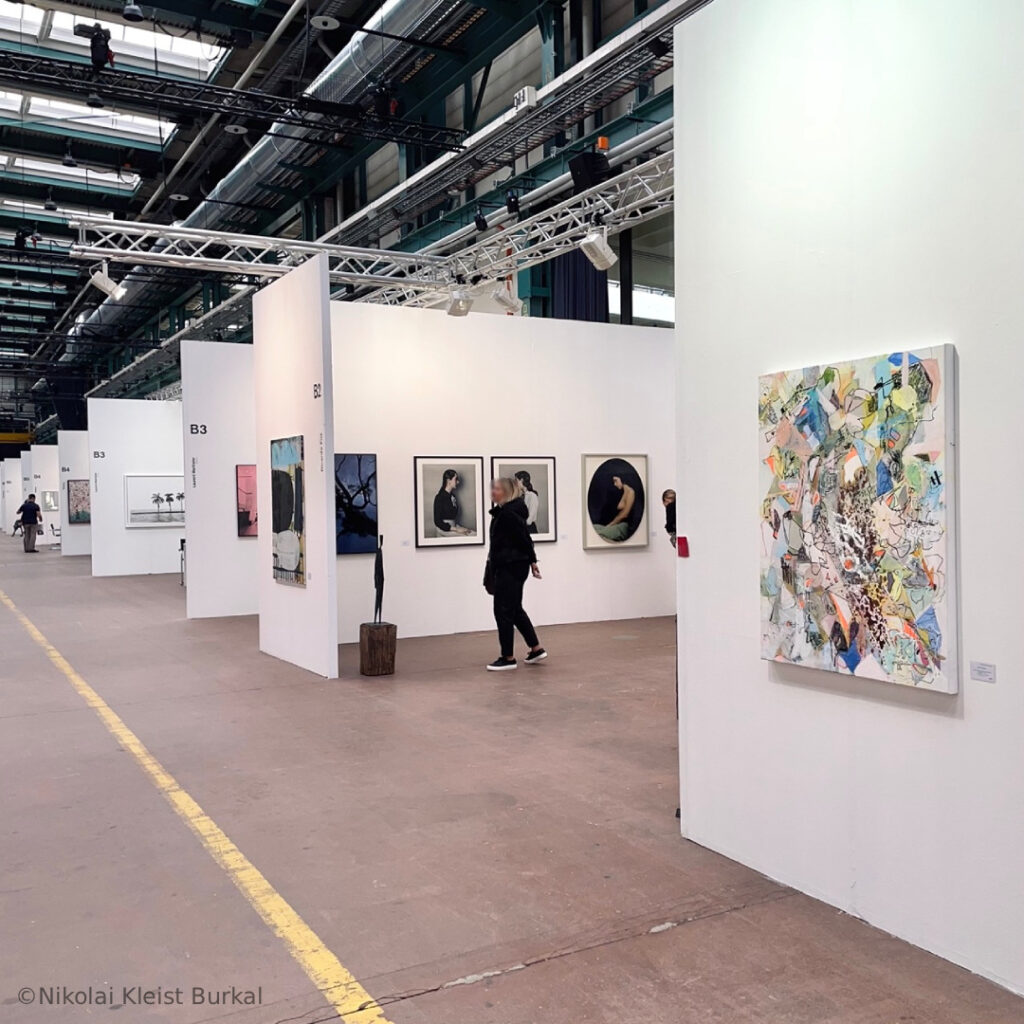
    Art Basel 2026 just closed its doors to this year’s fair. There has been some early reports of positive sales and appetite, while some have called the chosen works by exhibiting galleries safe and cautious. But, the article will not focus on what was sold where. Instead, I went to check out what the art is actually about, to see identify any common threads.

    The fair’s Unlimited section showcases large-scale artworks and installations, while established and galleries present international art ranging from Modern to Contemporary Art. This year, Art Basel introduced two new features, Zero 10, a curated exhibit of 20 technology-driven and digital art, as well as Basel Exclusive, an new initiative to try and bring back he in-person discovery to the art market, where selected high-value works would only be revealed at the fair instead of online pre-viewing and pre-sales.

    Photo: Michael Wilkinson at P.P.O.W, booth B10

    Art themes and approaching the fair

    This year, I took a slightly different approach to the fair, and got a lot more out of it, than previous years. Since the art exhibited can date back to early 1900s up until today, it doesn’t make sense to look at the older and well-establish blue chip artworks. The Picassos, De Koonings, and Cy Twomblys might be interesting for tracking art sales and buyer sentiment, but these don’t tell us much about contemporary art today.

    Photo: George Rouy, Art Basel Unlimited

    Art Basel exhibits 290 galleries with over 4000 artworks, so this is quite impossible to absorb everything if you also want to immerse yourself in the works. In order to focus on contemporary themes from the 2020s, I concentrated on works from 2020–2026.

    Then, based on personal observations and research, I tried to find works that fit the expected themes:

    • Art as tactile craft and authenticity through human traces
    • Personal surrealism and hyperindividualism
    • Tech-driven art
    • Historical reclamation and decolonial aesthetics
    Photo: Sfeir-Semler Gallery, booth J16

    This approach was a good way to get the most out of the fair as a visitor, but it can also leave you a bit blind to other themes. So, it is important to still stay open to new observations to avoid the preconceived notion of what contemporary art is today.

    Here’s what I found when applying this lens to the fair.

    A look at the works!

    Across the fair, there were numerous artworks across the fair focusing on traditionally craft materials such as ceramics and textiles. There were also quite a few newer works focusing on the human body and experience in a way to express memory, identity, trauma, and ancestral history.

    There was an increased focus on tech, by the fact, that Art Basel this year had launched its new section Zero 10 (after testing it at its fairs in Miami and Hong Kong), a curated section of 20 exhibitors dedicated to digital art and technology, as a way to close the gap between technology-drive and traditional fine art.

    Photo: Hito Steyerl at Esther Schipper and Andrew Kreps Gallery, new Zero 10 section at Art Basel

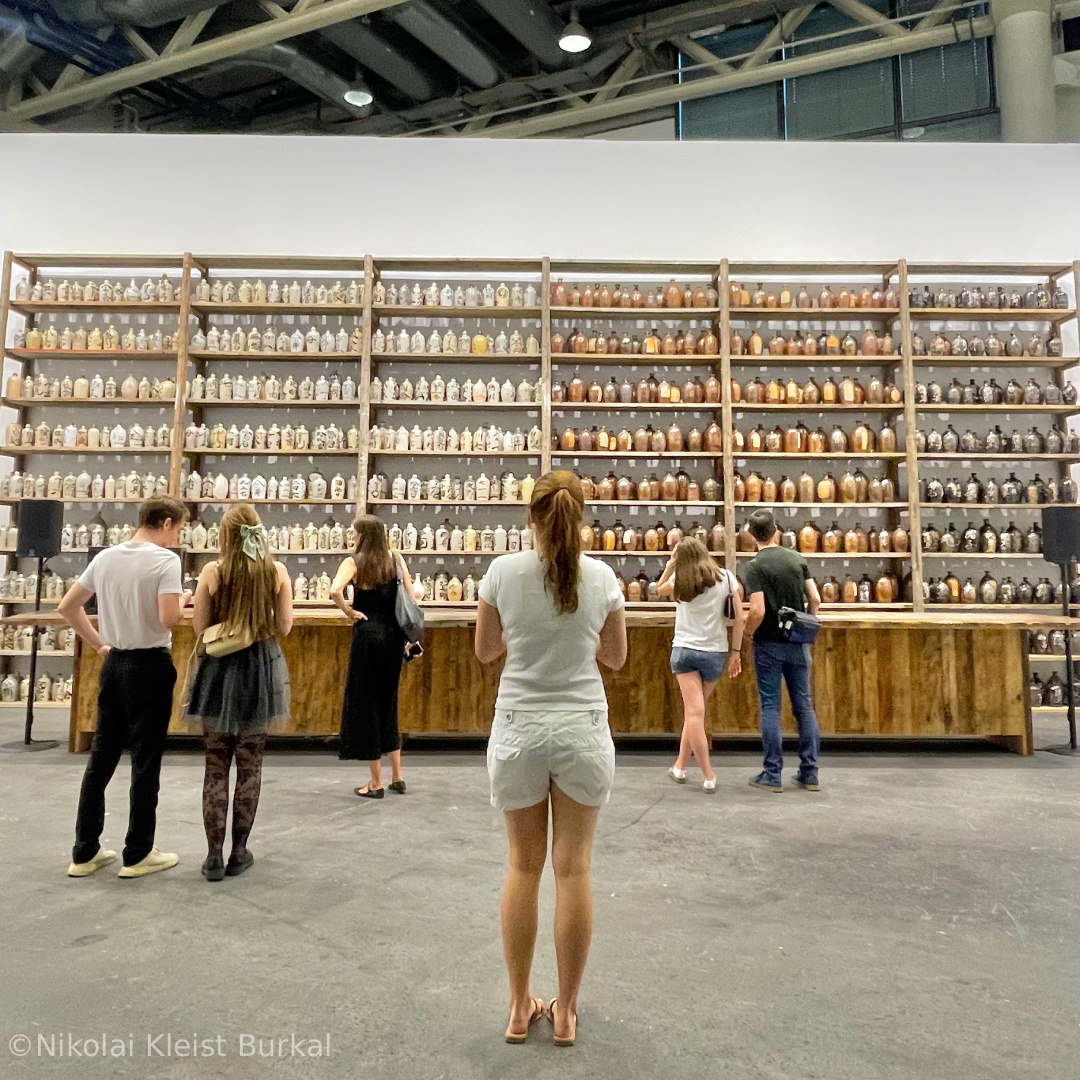
    The artwork by American artist Theaster Gates’s ‘A libation in Uncertain Times’ (2024) showed an installation of a large wooden shelve containing 1,000 Japanese sake jars. The work explores the artist’s concept of “Afro-Mingei”, a way of bridging Black identity and Japanese culture through traditional crafts like ceramics.

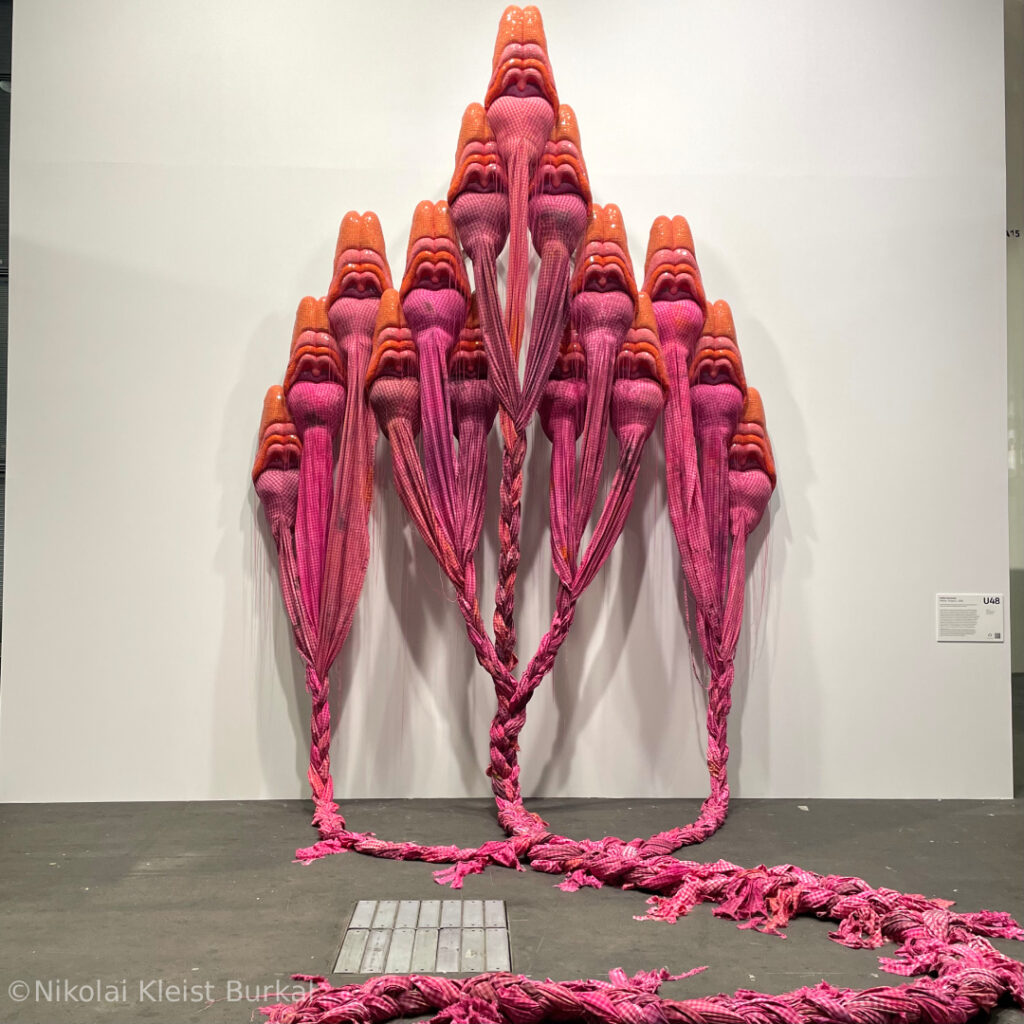
    Hungarian artist Zsófia Keresztes’ ‘Mother Tongue II’ (2026) showed a large wall-mounted relief of mouths covered with pink and red glass mosaics and textiles tongues dripping down and entangling on the floor. The artwork deals with the systems of language, with the braided tongues referencing childhood memory and domestic labor. The work attempts to embody inheritance, while balancing nurture and discipline, and autonomy and interdependence.

    Photo: Zsófia Keresztes’ ‘Mother Tongue II’ (2026), Art Basel Unlimited

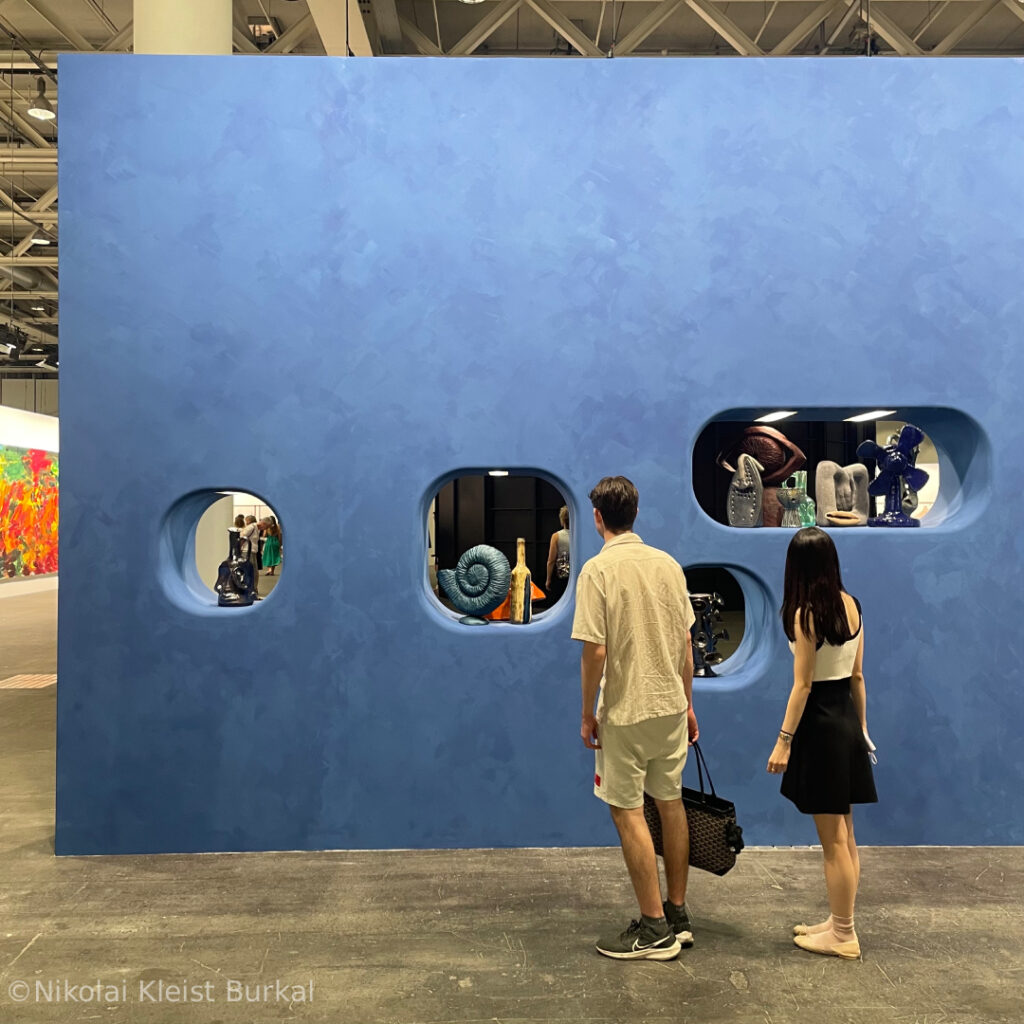
    American artist Woody De Othello’s ‘Two sides that hold truth’ (2026), showed a large blue freestanding wall with arranged glazed ceramic, glass, stone, and wood to turn domestic objects into objects with anthropomorphic qualities as a way to investigate the psychological and material depths of human feeling.

    Photo: Woody De Othello’s ‘Two sides that hold truth’ (2026), Art Basel Unlimited

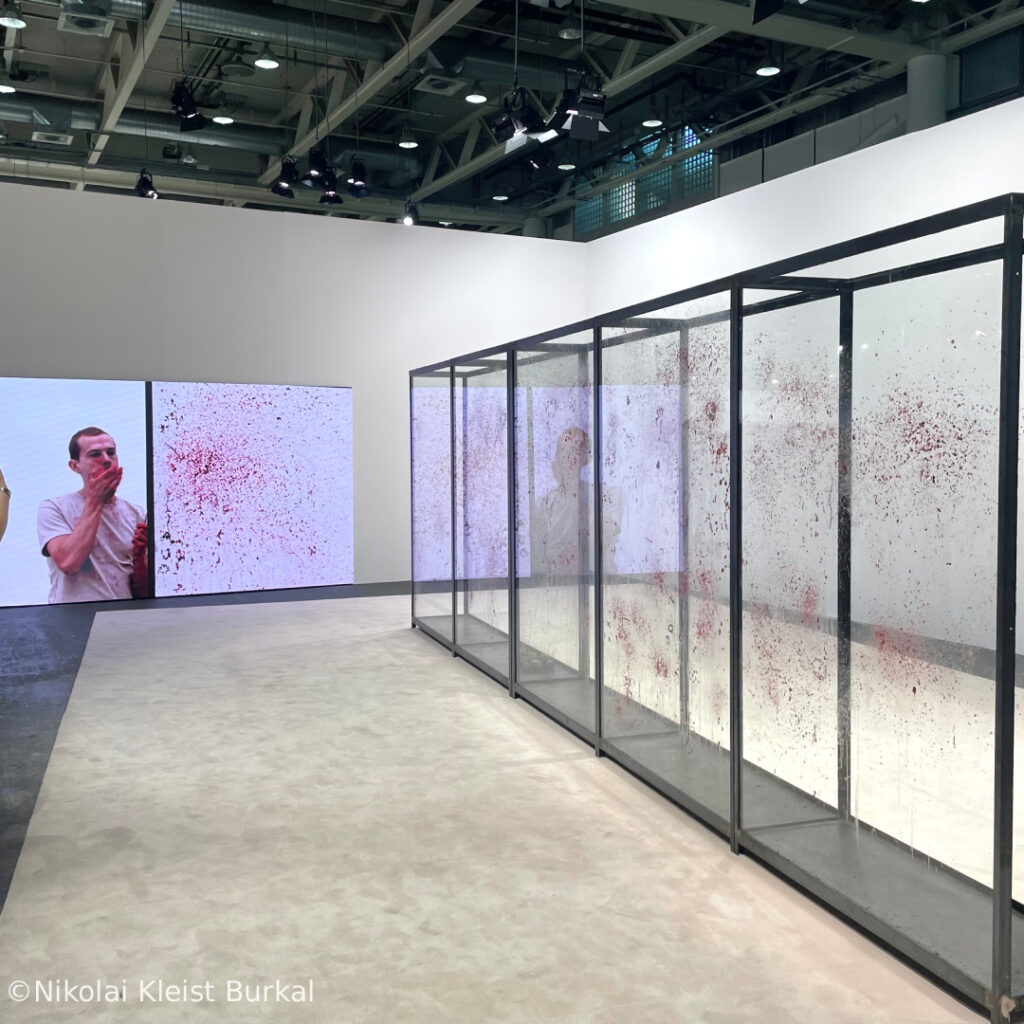
    Belgian artist Edith Dekyndt’s ‘The raw and the cooked’ (2024–2026), showed a performance and remnants of the performance as video and glass cage installation. A performer chews on a beetroot and sporadically spits its juice and pulp on the glass walls leaving a crime-scene-like mark on the glass. It aims at visualising the thin boundary between human and animal, nature and culture, as well as instinct and civilisation.

    Photo: Edith Dekyndt’s ‘The raw and the cooked’ (2026), Art Basel Unlimited

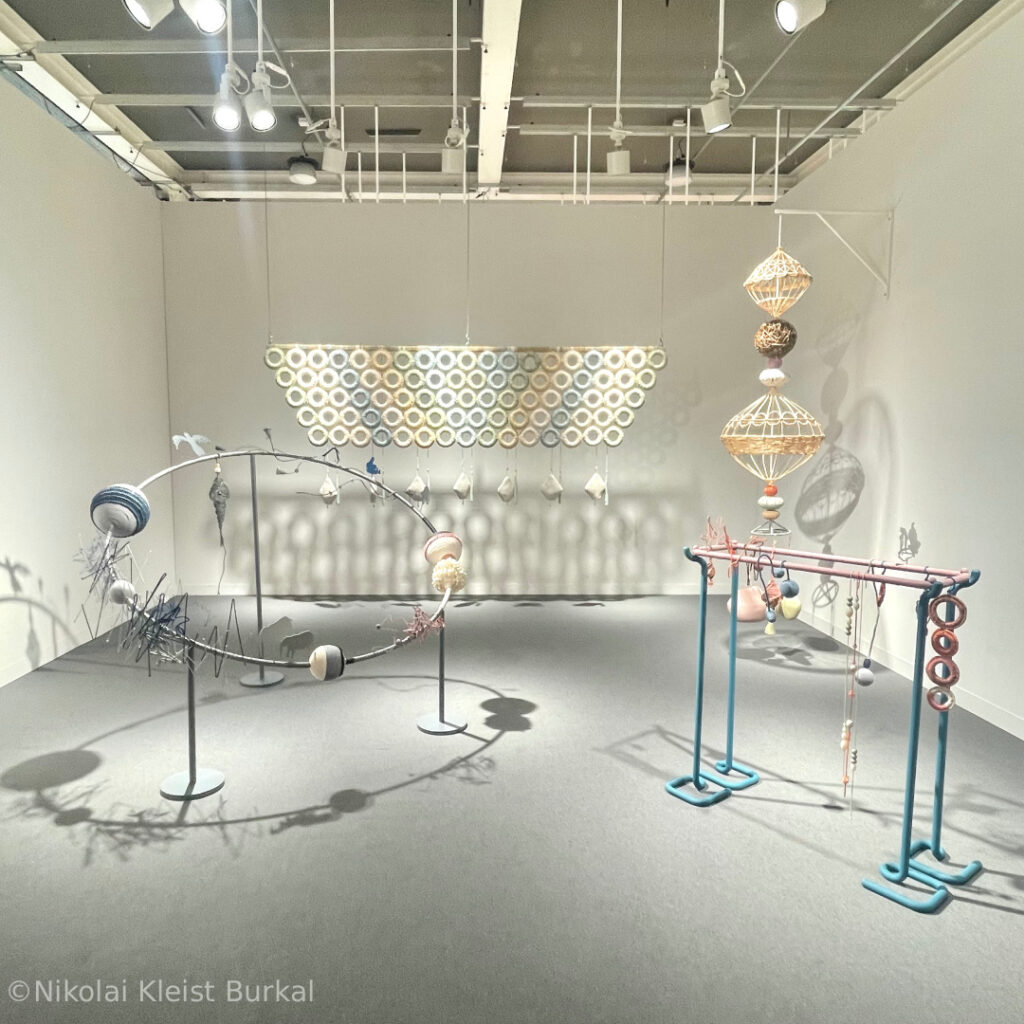
    In the gallery section of Art Basel, some interesting examples include PKM Gallery’s solo exhibition of Korean artist Young In Hong’s sculpture and installation based on craft material such as textile string and weave. The works aim to blend socio-political history, labour narratives, and traditional craft techniques.

    Photo: Young In Hong at PKM Gallery, booth P4

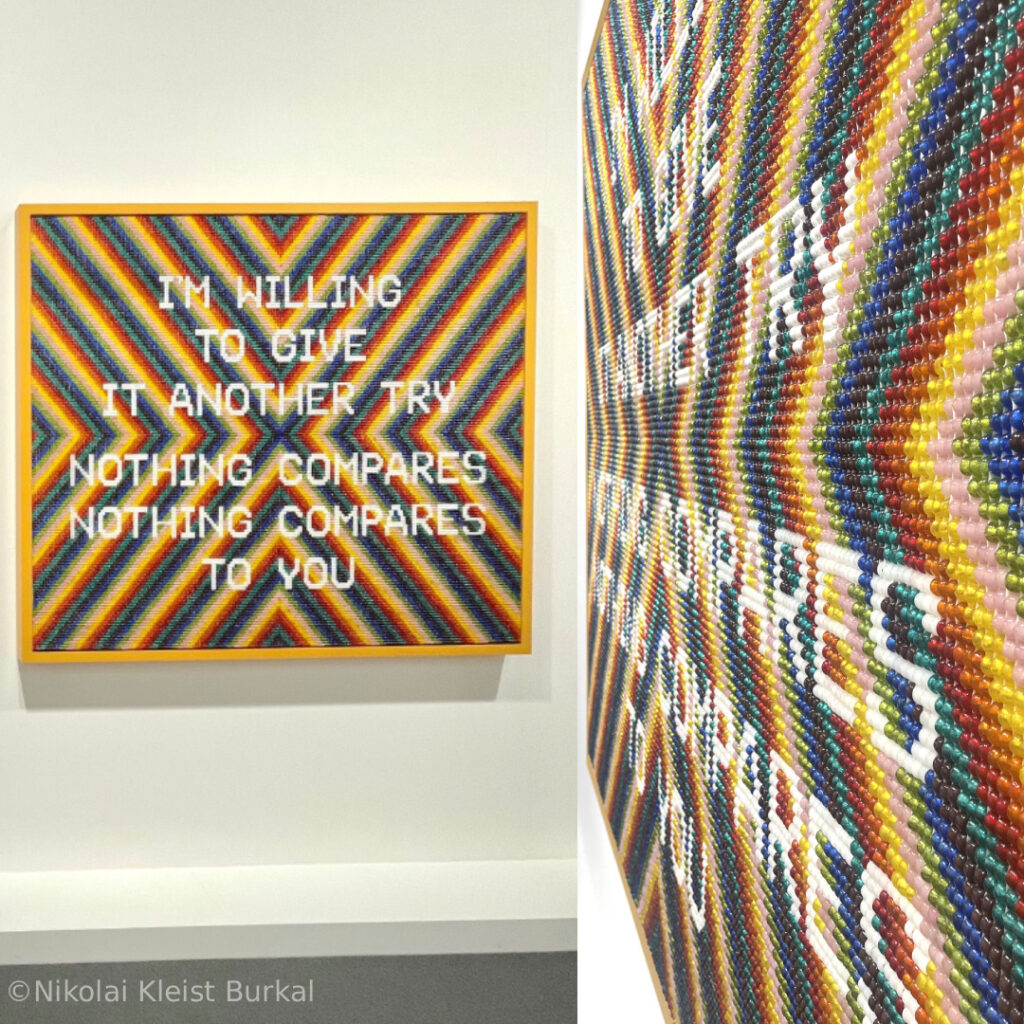
    Another good example was Jeffrey A. Gibson, a Native American artist represented by Hauser & Wirth gallery. His work ‘I am willing to give it another try’ (2026) is a combination of vibrant beadwork, word art and geometric abstraction. The work is a reflection on the cycles of relationships, human longing, and the complicated search for stability between opposing truths like certainty and contradiction.

    Photo: Jeffrey A. Gibson at Hauser & Wirth, booth C10

    What this tells us

    Looking at the contemporary art from the 2020s, what emerges from Art Basel 2026 is less a unified direction and more a fractured moment of urgent reckoning. Three impulses repeated across unrelated booths: a return to tactile, handmade materials; a focus on the body as a carrier of memory and experience; and a deliberate embrace of technology-driven practice. The fact that they coexist, not sequentially but simultaneously, tells us something about where contemporary art is right now.

    Photo: Han Mengyun at Shang ART, one of the new Basel Exclusive works at Art Basel

    You might say, contemporary art is at a major crossroads. Art is experiencing a fundamental mutation driven by digital virility, AI, and shifting economic models. It is interesting to see a push for technology-driven art and the love-hate relationship with AI, while some galleries have taken a more cautious approach by relying on blue-chip Modern and Post-war masters. The ghost of the failed NFT boom still lingers, but digital art is clearly being taken more seriously. What this poses a threat to traditional art, compliments it, or merely co-exists peacefully with it, is a little to early to say.

    Further reading

  • Art Genève 2026 and Indigenous Presence in Contemporary Art

    Art Genève 2026 and Indigenous Presence in Contemporary Art

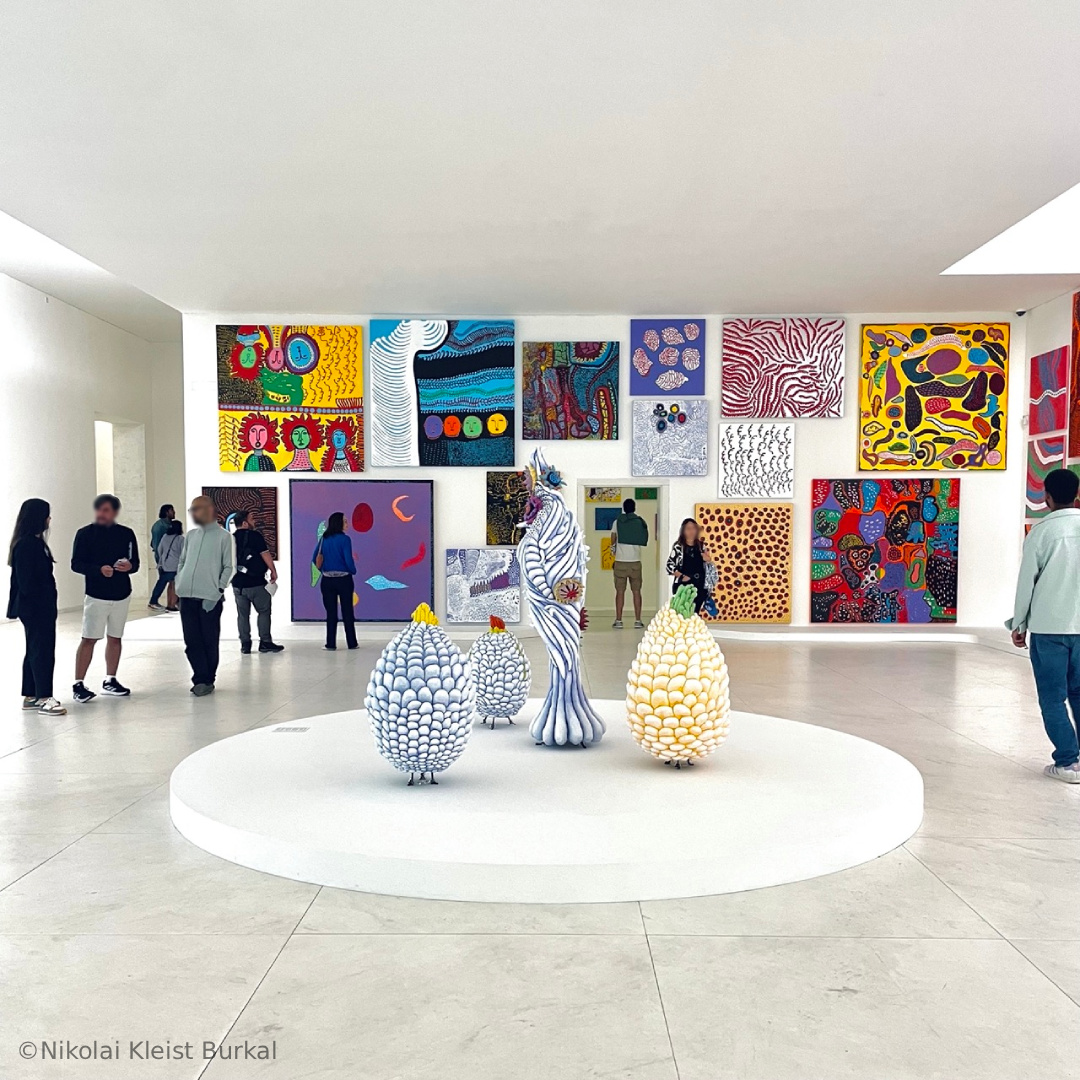
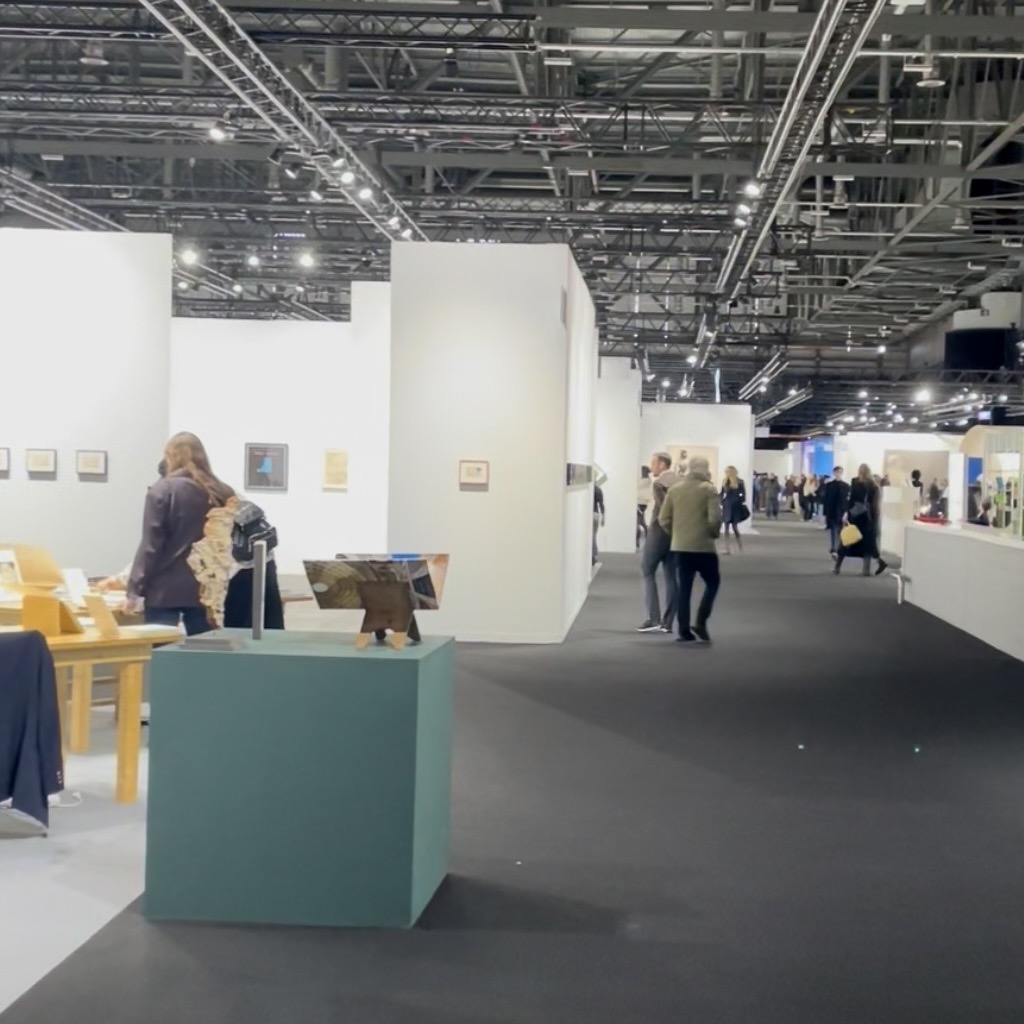
    Art Genève has just wrapped up its 14th edition. Art-Beats was on site to casually take the pulse of the market, speak with gallerists, and detect any recurring themes at this year’s fair, held from January 29 to February 1, 2026, at Palexpo in Geneva.

    Booth B31 Templon, Paris/Brussels/New York

    The fair at a glance
    Art Genève is arguably the second most prestigious art fair in Switzerland, following Art Basel. Often described as a “boutique” fair, it distinguishes itself through its smaller scale and strong curatorial focus. This year’s edition hosted around 80 galleries presenting modern and contemporary art.


    The fair maintains a strong connection to particularly francophone regions, attracting galleries and visitors from Swiss Romandy, Paris, Quebec, and Montreal. Beyond the main booths, Art Genève also features Special Projects, dedicated to foundations, institutional collections, and private collectors, as well as Solo Shows sections, allowing galleries to focus on one artists and more curated booths.


    One of the Special Projects was MAMCO Genève’s (museum of modern art) booth, which functioned as a live exhibition of works the museum planned to acquire during the fair. Beginning empty and gradually filling with newly purchased works, the booth made the acquisition process visible and inclusive — a bit unusual and somewhat refreshing gesture for an institution.

    Booth B39 gallery Semiose, Paris


    Several booths also showcased art award nominees. Luxury watchmaker Piaget continued its support by awarding the best Solo Show presentation at the fair, with the winning work entering MAMCO’s collection. Similarly, the Prix Mobilière 2026 presented seven nominated artists for their contributions to the Swiss art scene. These initiatives demonstrated how sponsorship can meaningfully strengthen collaboration between institutions and the market.

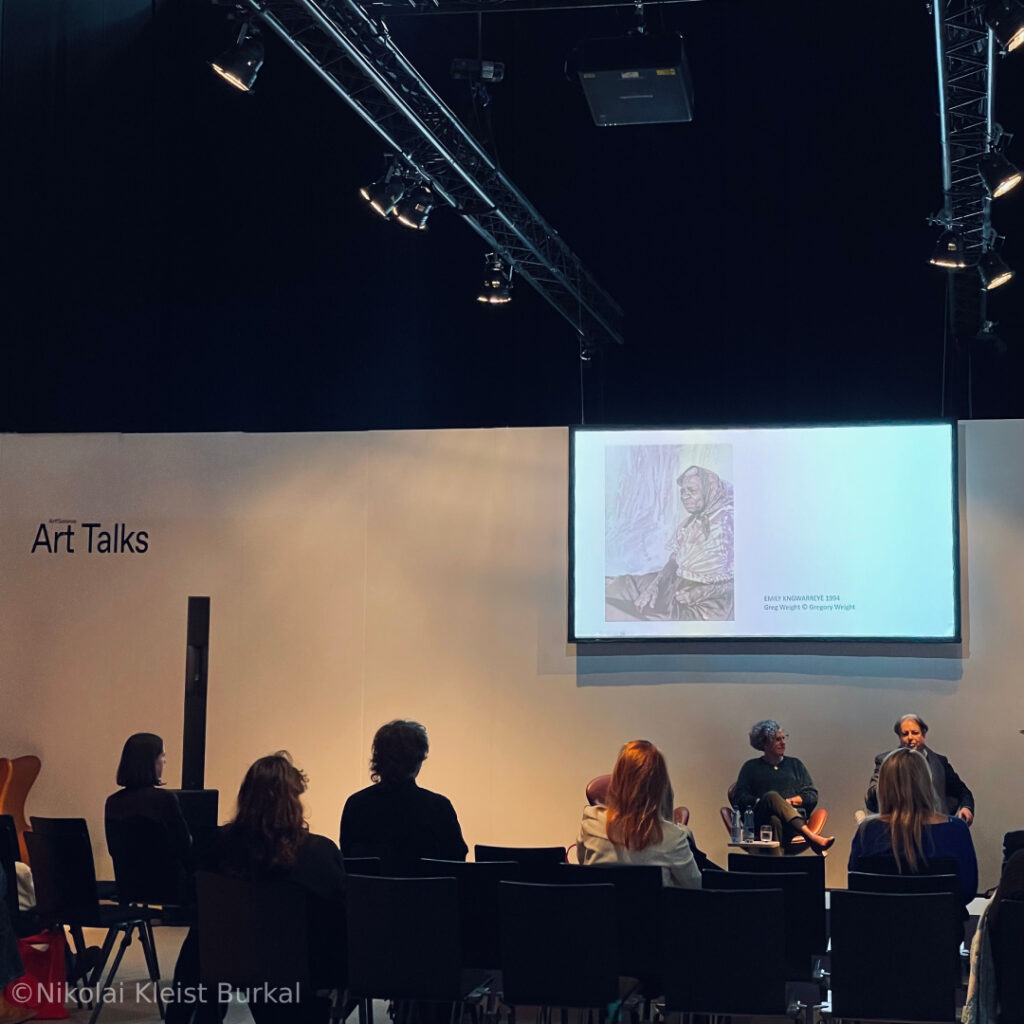
    Art talk “Contemporary Australian Indigenous artists”

    Some Art Talks topics

    As every year, Art Genève hosted a series of public talks. A recurring theme was the Responsible Art Market (RAM) – Art Market Perspective, which celebrated its 10th anniversary. The discussion addressed sustainability in the art world from multiple angles, including shipping practices, tax reforms, inheritance, and the economic sustainability of artistic careers. RAM continues to provide practical toolkits focused on due diligence, provenance research, and combating money laundering within the market.

    Exhibitors preparing at Art Genève


    Another theme, which I found particularly interesting, was the attention to indigenous presence in contemporary art. One talk I was looking forward to — Contemporary Australian Indigenous Artists — ultimately felt more like a presentation than a discussion and lacked depth on individual practices and introduction to artists and their works. Still, it touched on important topics such as oral traditions, the cultural significance of dreaming, which connects people with ancestral narratives in connecting past and present.

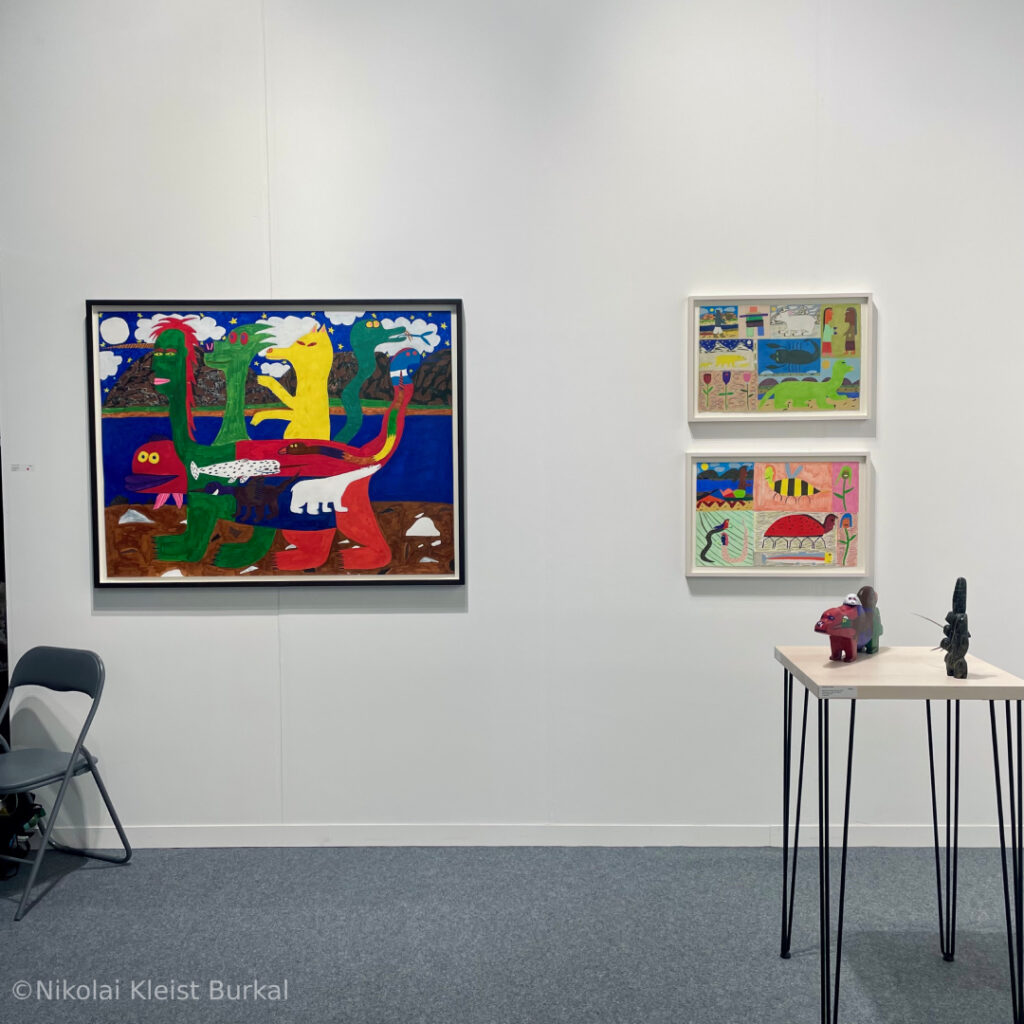
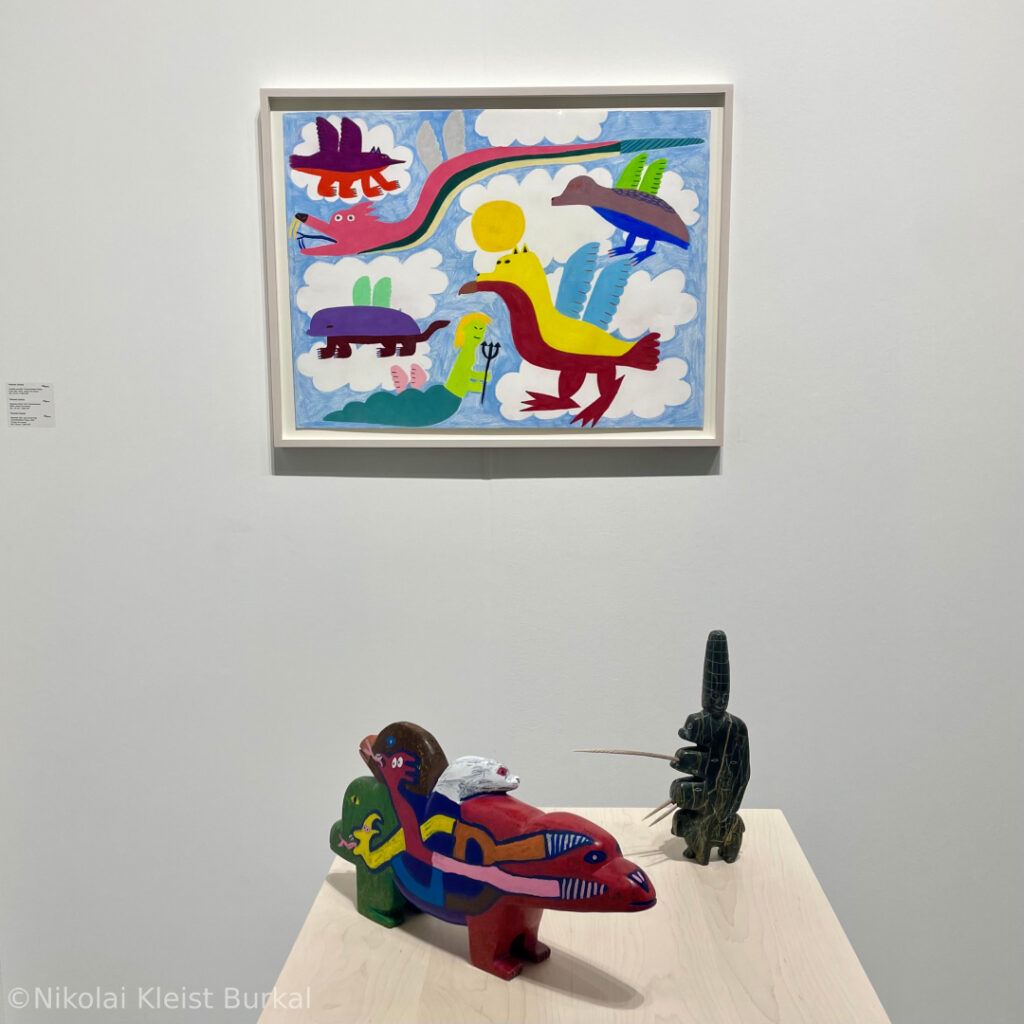
    Pitseolak Qimirpik’s Solo Show at D23 gallery Chiguer Art Contemporain, Montréal/Québec

    Highlights of the fair
    While it was enjoyable to reconnect with exhibitors and familiar art-world figures, what stood out most this year were the Solo Show presentations. Around 30 solo shows were presented by international galleries, many of which felt more focused and thoughtfully curated than standard booth displays.


    As a Danish-Greenlandic artist myself, I was particularly drawn to the solo presentation of Inuit artist Pitseolak Qimirpik (b. 1986, Nunavut, Canada) at Chiguer Art Contemporain, led by owner Abdelilah Chiguer. Seeing a solo exhibition by an Inuit artist at a well-established European fair felt significant, and made me think about the positioning of indigenous contemporary artists in general.

    Pitseolak Qimirpik’s Solo Show at D23 gallery Chiguer Art Contemporain, Montréal/Québec


    This presentation raised broader questions about how indigenous artists are positioned within the contemporary art market. As the art world increasingly focuses on previously marginalised voices — including artists from developing regions, women artists, and Indigenous communities — it remains unclear how these practices are expected to adapt to a well-established Westernised art market system, and whether that adaptation risks compromising cultural specificity.


    I don’t have definitive answers, but after an initial walkthrough, this was the booth that stayed with me, because it felt relevant — despite the fair also featuring blue-chip names such as Lee Ufan, Yue Minjun, Anish Kapoor, Paul McCarthy, and post-war figures like Hans Hartung and Karel Appel.

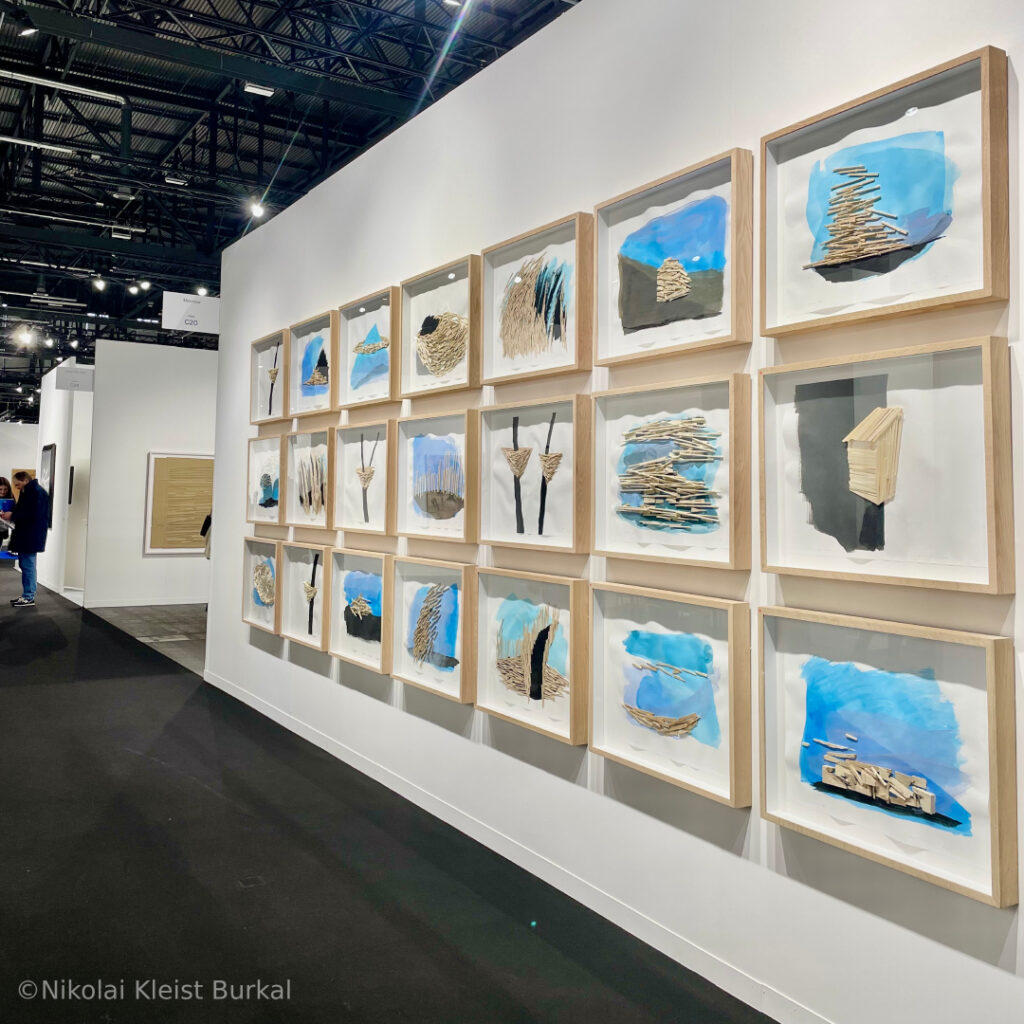
    Booth C20 Mennour, Paris


    Other solo presentations were equally engaging. Gallery espace_L’s exhibition of Jan Steenman’s ceramic, shelf mushroom-like sculptures reflected a broader trend I’ve noticed recently: contemporary ceramics increasingly occupying space within fine art galleries. Several other galleries such as Taste Contemporary from Geneva and the art association SALTS from Basel were also exhibiting ceramic sculptures, and I am wondering if there is an increased demand for these? It seems like it.

    Further Reading

    See also related articles

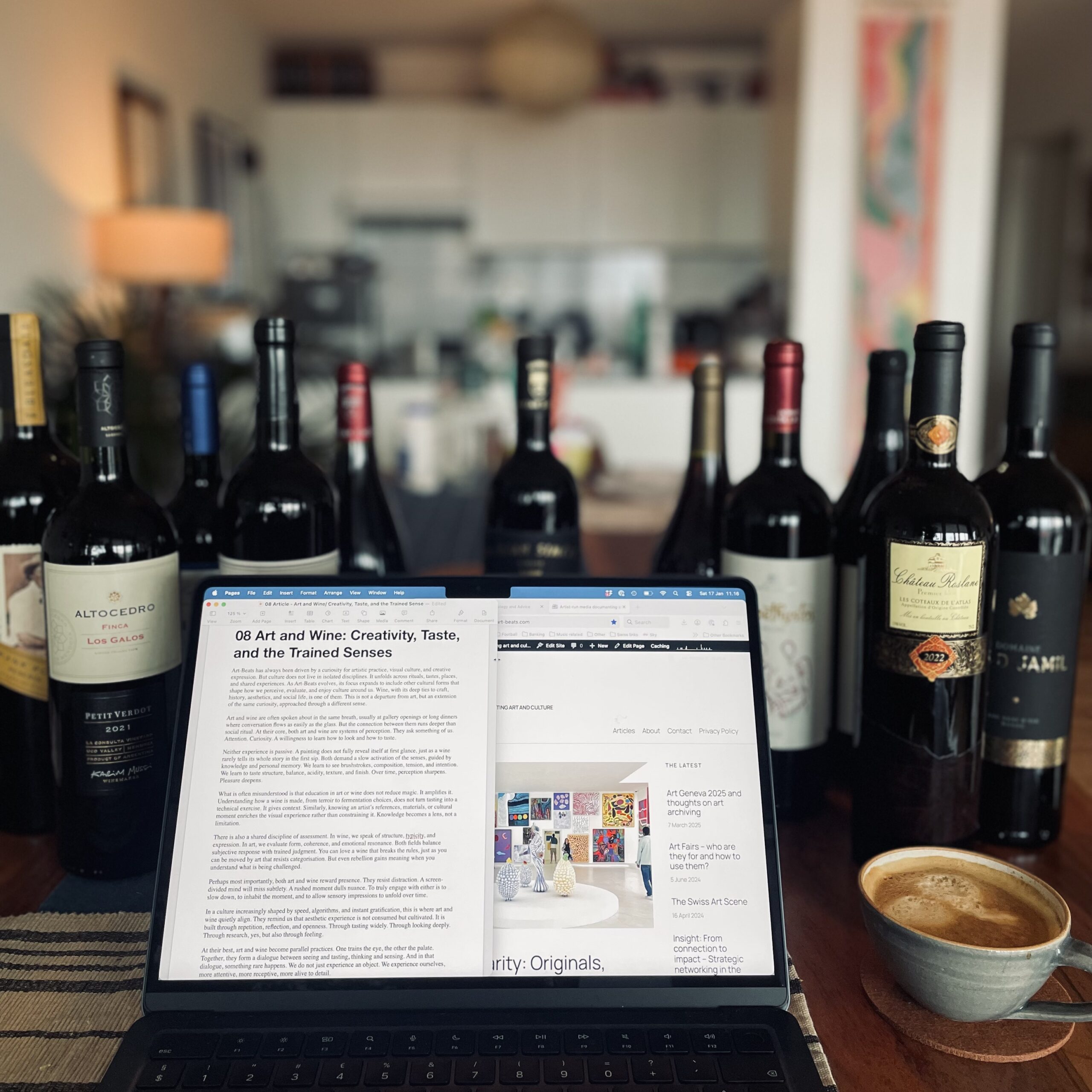
  • Art and Wine: Creativity, Taste, and the Trained Senses

    Art and Wine: Creativity, Taste, and the Trained Senses

    Since its launch, Art-Beats has been driven by a curiosity for artistic practice, visual arts, and cultural expression. But cultural disciplines do not exist in isolation. They are expressions of a shared cultural fabric, shaped by overlapping histories, practices, and ways of sensing the world. Culture unfolds across rituals, tastes, places, and shared experiences.


    As Art-Beats evolves, its focus aims to expand to include other cultural forms that shape how we perceive, evaluate, and enjoy the world around us. Wine, with its deep ties to craft, history, place, and social life, is one of them. This is not a departure from art coverage, but an extension of the same curiosity, approached through different sensory experiences.

    A Shared Cultural History: Art and Wine in Dialogue

    Caravaggio, Bacchus (c. 1598). Uffizi Gallery, Florence.


    The relationship between art and wine is also deeply embedded in cultural history. Wine has been a recurring subject in fine art for centuries, from Caravaggio’s Bacchus to the convivial scenes of Dutch Golden Age still life paintings or vanitas, where wine symbolised abundance, indulgence, and moral tension, like the fleeting nature of earthly pleasures and worldly pursuits.

    In contemporary culture, the dialogue between art and wine has become increasingly deliberate and conceptually rich. One of the most enduring examples is Château Mouton Rothschild, which since 1945 has commissioned leading artists to design its annual labels, including Pablo Picasso, Andy Warhol, and Gerhard Richter. These wine labels have become cultural markers, embedding each vintage within the artistic language of its time and transforming the bottle into a collectible object that carries both aesthetic and historical value.

    Pieter Claesz, Still Life with Herring, Wine and Bread (1647). Los Angeles County Museum of Art, Los Angeles.

    More recently, artists have begun to engage with wine not only as surface but as form and narrative. Daniel Arsham’s reinterpretation of the Moët Impérial bottle, rendered as a futuristic archaeological artefact, repositions the champagne as an object suspended between past and future, consumption and preservation. The work echoes Arsham’s broader practice of imagining contemporary objects as relics, and in doing so, invites reflection on how cultural value is constructed and remembered.

    Beyond high-profile collaborations, a growing number of producers are embracing art-inspired labels and artist partnerships as a way of articulating identity, place, and philosophy. In these cases, visual language becomes a means of storytelling, offering an entry point into the wine’s origin, values, and sensibility.

    Passion Assets, Perception, and Experience

    Luxury wines, some with hand-painted labels displayed at Tenuta Torciano Winery in Tuscany, Italy

    Art and wine are often spoken about in the same breath, usually at gallery openings or long dinners where conversation flows as easily as the glass. In financial portfolio management, as defined by the CFA Institute, they are even considered part of the same asset class, categorised as passion assets or collectibles. But the connection between them runs deeper than social ritual. At their core, both art and wine are assessed through systems of perception. They encourage engagement. Demand attention. Evoke curiosity. A willingness to learn how to look and how to taste. And perhaps most importantly, both art and wine reward presence.


    Neither experience is passive. An artwork does not always reveal itself at first glance, just as a wine rarely tells its whole story in the first sip. Both often require a slow activation of the senses, guided by knowledge and personal experience. By intentionally looking, we learn to see brushstrokes, composition, expression, and intention behind an artwork. Sip by sip, we learn to taste structure, balance, acidity, texture, and finish of a wine. Over time, our perception sharpens. Pleasure and appreciation deepens.

    Assessment, Criticism, and Contemporary Pressures

    There is also a shared discipline of assessment. In wine, we speak of structure, typicity, and expression. In art, we evaluate form, coherence, and emotional resonance. Both fields balance subjective response with trained judgement. You can love a wine that breaks the rules, just as you can be moved by art that resists categorisation or conventions. But even rebellion gains meaning when you understand what is being challenged.
    Both art and wine are also shaped by ongoing criticism, debate, and shifting evaluative frameworks. In wine, discussions increasingly centre on how climate change is altering traditional styles and regional identities, how producers respond to evolving consumer expectations around sustainability and moderation, and how economic pressures affect production and distribution. These debates challenge long-held notions of typicity and quality, prompting producers and critics alike to reconsider what excellence looks like in a changing world.

    In the art world, assessment is similarly influenced by broader cultural and structural pressures. Questions of access, visibility, and economic sustainability continue to shape artistic practice, alongside debates about how digital platforms, institutional gatekeeping, and global audiences redefine value and authorship. At the same time, artists are navigating expectations around authenticity, social relevance, and cultural responsibility, often working across disciplines and formats that resist traditional modes of critique. In both fields, judgement is no longer fixed but negotiated, reflecting a cultural landscape in flux.

    Final Thoughts

    In a culture increasingly shaped by speed, algorithms, and instant gratification, this is where art and wine quietly align. They remind us that aesthetic experience is not consumed but cultivated. It is built through repetition, reflection, and openness. Through tasting widely. Through looking closely. Through research and experience, yes, but also through feeling and sensing.

    Further Reading & Sources:

  • Art and Rarity: Originals, Editions, and Reproductions

    Art and Rarity: Originals, Editions, and Reproductions

    What does uniqueness of an art work mean – and what influence does rarity have in today’s art market?

    The question is rooted in my own initial discontent of the commodification of fine art. Perhaps, due to a tendency of romanticising important or relevant fine art as unique or “one of a kind”, which is a dangerous thing to do. This thought might narrow your mind to “what art should be” as a reaction to “what art has become”. So, in an effort to educate myself, and better explain this aspect of art production to others, I am here looking into the levels of rarity art may be produced under, and why does this matter.

    From ancient Chinese woodcuts to Andy Warhol’s silk screen prints, the tension between originality and reproduction has always been central to the art world. Today, with artworks sold everywhere from international fairs to online platforms, understanding the difference between unique works, editions, and reproductions may seem useful – for artists, collectors, and audiences alike.

    Kunsthaus, Zurich

    3 Encounters with Art Rarity

    My reflections on this topic stem from a couple of personal encounters:

    The Picasso Print: A friend once asked me about a lithograph advertised as a “Picasso” for around $500. My friend asked me why it was so cheap, and whether it would be a good purchase. The real question wasn’t whether the piece was authentic, but whether it was a limited edition, an open edition, or simply a fancy poster. Rarity, as well as who produced or printed it, as well as the quality of the edition, could determine the value.

    An Yves Klein in Manila: At Art Fair Philippines some years ago, I saw what appeared to be an ultramarine coloured sculpture advertised as Yves Klein’s Blue Venus. The work, I later researched, was conceptualised by the artist, but was only produced after the artists death in limited production of 300 sculptures. The work is dated 1962/1982 for when it was initially conceptualised, and when it was actually produced with authorisation by the artist’s estate 20 years after his death – it was priced around $100,000. This triggered some questions in me; was this an ambitious effort to democratise Klein’s work, or a bold attempt to commercialise a legacy? You can find editions of this sculpture at many prominent museums and galleries around the world, which adds legitimacy and value to this posthumous work. See an example of one of the editions here on The Met’s website.

    Edition-Only Galleries: In cities like London and Paris, I’ve passed by gallery streets selling, sometimes exclusively, certified prints, editions, and replicas. These spaces illustrate how entire business models can revolve around the reproducibility of art. These galleries also often appear in major art fairs, selling artworks by the likes of Francis Bacon, Dalí, or Basquiat. The artworks represent a mid-range segment of the market, between very affordable and very expensive blue chip art.

    Each of the experiences above revealed how fluid the boundaries are between original, edition, and reproduction – and how much these definitions matter in shaping perception and price.

    Art Zurich 2022

    Why Rarity Matters in Art

    As mentioned, art is sometimes romanticised as “one of a kind.” We imagine the solitary artist creating a singular masterpiece, preserved in time. But reality is more complex, and there are different reasons why it would make sense to break up a unique artwork into limited editions and reproductions.

    Today, the art markets thrive on accessibility, affordability, and scalability. Collectors now navigate a spectrum of artworks – from originals to certified editions, prints, and posthumous reproductions. Each category raises important questions about value, authenticity, and intention.

    Rarity plays a crucial role in setting expectations. For collectors, understanding whether a piece is unique, limited, or open edition directly affects the assessment of its value. Editions inevitably reduce a work’s uniqueness, but that does not necessarily diminish its quality. Compared to unique works by the same artist, editions are typically more affordable, though it can be argued that editions can reduce the cultural weight of each individual piece.

    It is also important to distinguish between editions and variations. Variations – like Edvard Munch’s The Scream, exists as several oil paintings and pastels – are variations of the same motif across different media. Editions, by contrast, are identical works produced in a numbered or open series, which would be the lithographic prints of The Scream. Nowadays, all the artworks produced during the artist’s life would be considered important, while the earliest completed version from 1893 produced with oil and tempera on cardboard would arguably be the most famous and studied version. Read more about the work on the MUNCH Museum’s website.

    When Art follows Technology

    The medium of an artwork dictates the possibility of producing art in editions. Like fine art photography, video art, or digital art, artworks can practically be reprinted or redeveloped in as many copies as needed, if the owner possess the negatives or original file. In some instances, the artist may choose to only print a photo in a limited number, choose high quality prints that are difficult and costly to make to ensure quality and integrity of the work. For digital art, the artist may choose to sell the original file or as a non-fungible tokens (NFTs), where uniqueness is secured by a distinct digital code stored on blockchain. The NFT market, which saw a boom in 2021 followed by a steep decline in 2024, is still considered an emerging market as reported by Art Basel in 2024.

    Originals, Editions, and Reproductions: What’s the Difference?

    • Unique Artworks: Paintings, sculptures, or installations created as singular pieces. These works embody the “one-of-a-kind” ideal and includes variations on a theme.
    • Limited Editions: Prints, photographs, or multiples produced in a set number. Each is signed and numbered, often retaining significant value.
    • Open Editions: Works reproduced without a set limit—making them more affordable, but less rare.
    • Reproductions: Replicas of existing works, sometimes produced posthumously. These can be authorised by estates or entirely unauthorised.

    It is important to note, that some artworks are only produced as prints, often in editions, but they are not reproduction. These prints are each considered original prints, as the artwork can be carved out on wood, etched into a copper or zinc plate, or drawn on lithographic stone.

    Understanding these categories helps collectors set realistic expectations while giving artists different ways to balance accessibility with financial sustainability. Not every artist can make a living solely from selling unique works one-by-one, and some mediums are especially well-suited to editions. At the same time, editions and reproductions can sometimes feel as though they dilute the intrinsic value of art, reducing it to something more commercial, like derivatives of original works.

    There seems to be a fairly large interest in prints and editions, with the secondary market for mid-segment (below USD 50.000) made up 7% of the art market in 2024, according to MyArtBroker. I would still make the argument, there is a big difference between editions made by the artist’s hand or supervision, and posthumous editions that are banking on the artist’s legacy. For collecting purposes, it is always relevant to ensure a certificate of authenticity, check for artist signatures, check whether edition is numbered, and whether date of print corresponds to the artist’s lifespan.

    For buyers, the key is to recognise these distinctions. Price is one factor, but of course, the most important question to ask yourself remains simple: Do you like the artwork?

    Art14 London

    Opportunities and Challenges of Editions

    Producing editions can be a lifeline for artists. It allows them to:

    • Reach wider audiences at lower price points
    • Create steady income streams alongside unique works
    • Engage with techniques like photography, printmaking, and digital media

    But editions also raise challenges:

    • Prints on paper can be fragile over time
    • Oversupply can dilute artistic value
    • Posthumous reproductions may spark ethical debates
    • Commercialisation risks turning art into pure commodity

    Some Closing Thoughts

    The rarity of an artwork is not just about economics – it’s about meaning. When a work is produced as a unique piece, its singularity becomes part of the story. When it is reproduced, its accessibility carries a different kind of cultural value.

    It can be argued, that the artistic integrity and value can still be preserved if the editions are treated like originals, in the sense of documenting, numbering, and certifying each piece. Unlimited quality prints can be considered high-end posters, which is completely fine, as long as this is transparent and clearly communicated to the buyer.

    Perhaps the key is not to treat rarity as a hierarchy, but as a spectrum of artistic practice. Unique works, limited editions, and even reproductions all have their place – provided we understand their context, purpose, and artistic intent.

    For further reading:

  • Art Geneva 2025 and thoughts on art archiving

    Art Geneva 2025 and thoughts on art archiving

    Art Geneva 2025 took place from 30th January to 2nd February 2025 at the Palexpo in Geneva. This was the second time I visited the fair, and I was curious to see how this mid-sized art fair was developing.

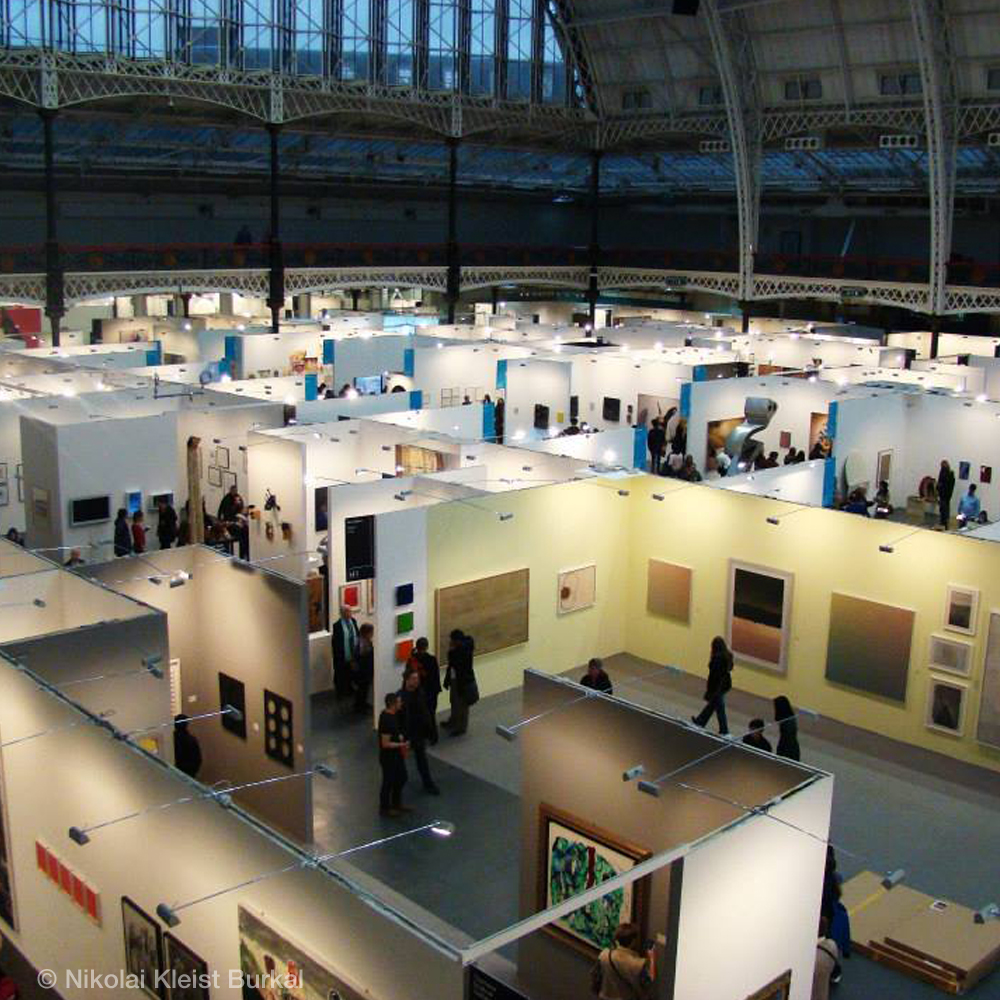
    Art Geneva is significantly smaller than Art Basel and Frieze. It hosted around 80 galleries, divided between those displaying catalogues of artists and those focusing on solo shows. There was a curated section for larger works and two spaces dedicated to awardees and the recognition of Swiss artists. In addition, there was a café, a bar, a restaurant, a partners’ lounge, booths for publishers, and an art talk space.

    But what I found interesting in this fair, was the art talk about the practices of art archiving.

    Art Geneve 2025, art talk space

    Archiving art
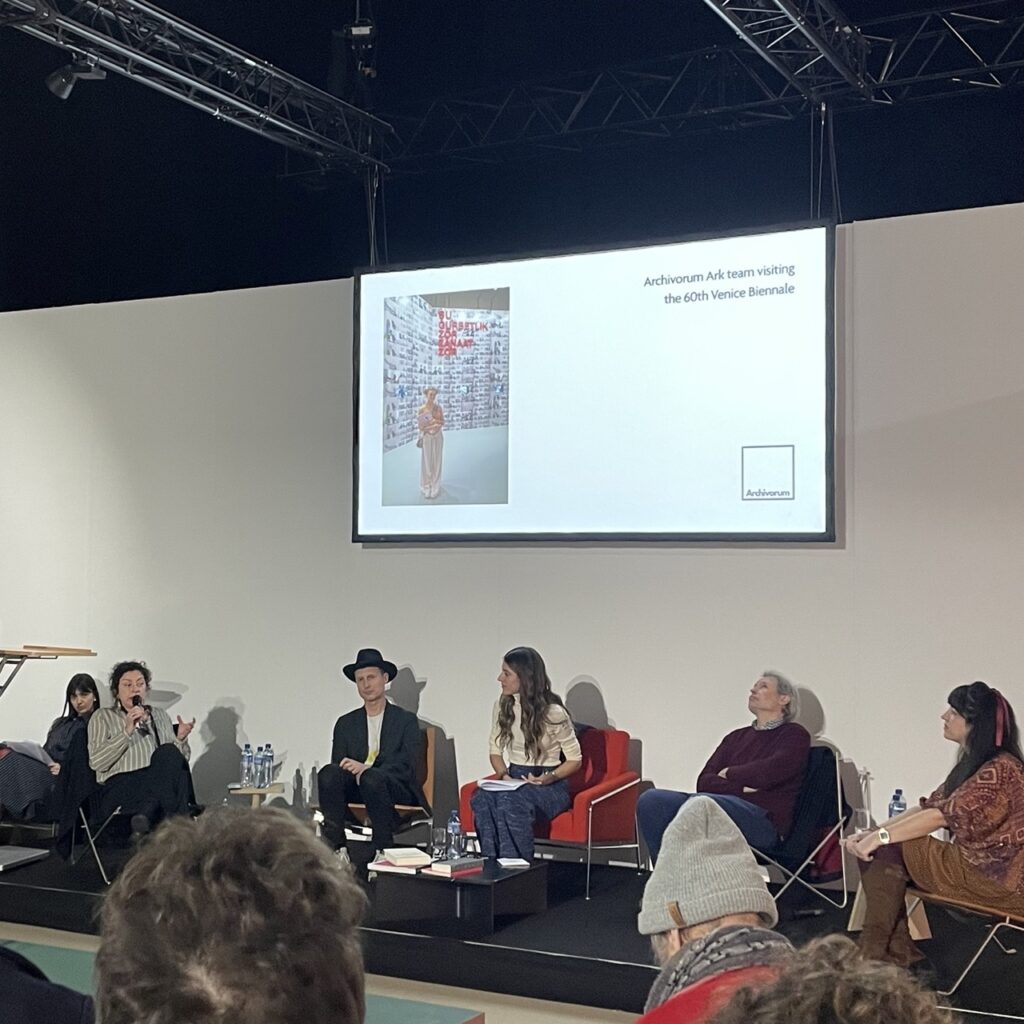
    I started my visit by attending the art talk “Archivorum Ark – Chapter 2: The Practice of Archiving Art and Bridging Time and Memory.” I recognised this theme from last year; I suppose that is what they meant by Chapter 2. The dedicated art talk space was larger and much better staged than in 2024.

    It took a while to introduce the panelists, but through their introductions, you already gained a good overview of the theme and the practices surrounding the archiving of art. This is not a theme I have given much thought about in the past, but it raised some interesting points. What happens not only to all the artworks in an artist’s private possession but also to all the notes, photographs, sketches, diaries, or any other supporting documentation that might help others understand the artist’s life, thoughts, and art process when the artist passes away? What are the practices for gathering and sorting this material, who keeps it, and what is it used for?

    It is interesting because not all artworks are suited for sale, and not all museums can store full archives of all artists. So, who maintains these materials, and what are the methodologies used for preserving them?

    It is easy to imagine that some blue-chip artists have extensive and valuable material stored in large museums, especially museums dedicated to specific artists. Similarly, galleries representing the estates of famous artists often hold a considerable amount of material, including archives of artworks. But what about lesser-known artists, or those deemed historically important after they have passed away?

    Artist legacy and the preservation of ideas are key topics and challenges in the role institutions play in educating, mediating, and curating exhibitions for the public. In this context, good cataloguing and archiving practices seem essential. This is particularly true for exhibitions that publish art books alongside the exhibitions themselves. Achieving this requires, first and foremost, someone dedicated to the task, gaining access to the stored documentation, and possessing the expertise to catalogue, digitise, and organise this information for specific or future use.

    That is where Archivorum Ark seems to come in. It is a relatively new organisation, established in 2023. It manages a library, organises public events, and conducts research projects. Its aim is to preserve, provide research, and educate about artists’ archives from around the world. Projects can be granted to artists or other art professionals who have a specific research project in mind, which might result in public events or publications, such as artists’ books.

    I think this initiative has a fantastic philosophy and concept. It raises important considerations about what happens to all the art we, as artists, produce. How do we document our work and process, if at all? And how do we properly hand over artists’ archives to researchers and custodians?

    Art Geneve 2025, Von Bartha gallery

    Responsible Art Market Conference
    The 9th edition of the Responsible Art Market Conference (RAM) is an annual event that takes place at the Palexpo during Art Geneva. It was held on Friday, 31st January, so I was unable to attend, but I thought it would be relevant to mention.

    Like the practices of archiving art, this conference also seeks to address and solve practical challenges in the fine art world. Art experts attending the conference discussed topics such as artwork commission contracts and pricing, responsible art market practices, non-resale clauses, and the impact of art speculation on the sustainability of artists’ careers.

    Some of the topics seemed to address broader issues, while others focused on specific and practical challenges. From my experience and work with ESG risk data, I know that words like “responsible” and “sustainability” should be used with care, as these terms are often exploited as smokescreens to make poor practices appear better than they are. I am not suggesting that this is the case here, and since I did not attend, I can only share the details about the conference’s intentions.

    That being said, the topic of fine art and sustainable practices is an important one, and I should consider dedicating a separate article to this subject.

    Art Geneve 2025, galleries at fair

    The fair as a whole
    Looking at the rest of the art fair, I think there was a good mix of young and established artists. I counted about 30 galleries from or based in Switzerland, 24 from France, a few from Italy, Belgium, and the UK, as well as four Asian galleries. There were 30 solo shows, meaning galleries exhibited artworks by a single artist. I think this was a great approach. It signals the intention of galleries to highlight an artist, allows them to curate their booth more effectively, and, for future sales, the gallery can mention to potential buyers that the artist had a special show at this fair. As a fair visitor, it also provides a better understanding of the individual artist’s ideas and concepts.

    I must note, having attended many art fairs, there are some artists you can always expect to see, such as Lee Ufan’s signature minimalist brushstroke paintings, Günther Förg’s multi-coloured grid paintings, there are always a couple of Picassos, and reproductions of Francis Bacon or Salvador Dalí in ghastly golden frames. While I understand there is a market for reproductions, I tend to skip them. I could dedicate a whole article to editions and reproductions, which could be another idea for the future.

    All in all, Art Geneva was a positive experience. I gained a quick insight into some of the current discussion points in the art world. In terms of the art itself, I did not experience anything particularly new or groundbreaking, but that would have been too much to ask for. In comparison to Art Basel, which is by far the largest fair in Switzerland (and Europe), Art Geneva offers a more casual and intimate setting, which serves as a good platform for art discussions and opportunities to converse with gallerists.

    If you want to hear more about eh Swiss art scene, check out previous article The Swiss Art Scene.

    If you are interested in the world of art fairs, check out Art Fairs – who are they for and how to use them?

    Further Reading:
    Art Geneva 2025
    Archivorum Ark
    Responsible Art Market Conference

  • The Swiss Art Scene

    The Swiss Art Scene

    Interview about the Swiss art scene, Art-Beats, and my art practices now available via Rigby AG’s youtube channel.

    From Greenland to Switzerland

    The interview by Kathrin Spinnler from Rigby AG touches on topics like my artistic journey from growing up in Greenland, my years in the Philippines, and ultimately ending up in Zurich, Switzerland. The interview also includes first impressions of life in Switzerland, and a mapping of the Swiss art scene.

    The Swiss Art Scene

    The Swiss art scene, with its high number of museums and funding opportunities, provides ample opportunities for artistic engagement. The country’s excellent infrastructure allows easy access to various art venues across all the biggest cities. Zurich’s Kunsthaus and other major museums offered a wealth of exhibitions and events, while initiatives like free museum admissions on certain days make art accessible to all.

    Among the highlighted venues in Zurich include Haus Konstruktiv, known for its focus on constructivist art and engaging exhibitions, and the more underground venue Rote Fabrik, which offers an alternative cultural experience. Beyond Zurich, venues are highlighted in cities like Basel, renowned for annual art fair Art Basel and institutions like the Fondation Beyeler and Kunstmuseum Basel.

    Creating art in Switzerland and some advice

    Depending on your level and intention of your artistic practice, there are several options for emerging professional professional artist and for people wanting to get started. There are availability of atelier spaces throughout major cities like Zurich, often listed on specialized websites or the canton’s website, which provides artists with affordable and conducive environments for creation.

    For beginners, I share some recommendations such as engaging in workshops offered by art supply stores like Bösner, which provide a social and educational introduction to various art forms. For those aiming to pursue art professionally, attending vernissages, subscribing to gallery newsletters, and applying for residencies are essential steps. Cities like Zurich and Basel, with their rich art scenes and robust infrastructure, offer numerous opportunities for networking and growth.

    Have a listen to the full interview and browse through the various topics covered tagged in the timestamp.

  • Insight: From connection to impact – Strategic networking in the arts

    Insight: From connection to impact – Strategic networking in the arts

    Art and culture programme consultant, Malaya del Rosario, shares her thoughts and advice on how arts organisations can optimise network-building initiatives.

    Networks play a pivotal role in the sustainability of art organisations, yet the question of how they can be optimised remains largely underexplored. Many art leaders and managers perceive network-building as a ‘nice to have’ rather than an integral part of their strategic plans, overlooking its untapped potential for fundraising, advocacy, and teambuilding.

    Strategic network-building can offer an invaluable system of support, which is crucial for an organisation’s growth and impact. It involves nurturing internal and external relationships and understanding how to manage diverse stakeholders who may have different perspectives and conflicting motivations. If done successfully, these links can contribute to both the short and long-term mission of your team.

    As an art manager who has worked for both small organisations and global cultural institutions across different geographic contexts, I have encountered all kinds of challenges in network-building. How much time do I invest in it? How can my organisation benefit from it? Can I really link it to tangible results? In this article, I aim to summarise these barriers and propose practical solutions to organisations looking to refine and streamline their activities.

    Why bother?

    Strategic network-building can significantly enhance an organisation’s operation by diversifying funding sources and reducing financial risks. It can also help increase impact through resource-sharing and alliances. International partnerships can expand audience reach, while leveraging technology optimises communication and reduces costs. For bigger institutions, having a strong, internal network can foster strong connections among team members, creating a more inclusive, equitable and collaborative work culture.

    Photo credit: Revital Salomon, 2016.

    Overcoming challenges

    Lack of a purpose. Without a clear purpose or vision, it will be difficult to engage stakeholders. Networks should be able to articulate their goals, values and how members can benefit from them. This allows stakeholders to assess their relevance and level of participation. While I was Head of Arts at the British Council in the Philippines, we identified the newsletter as an effective way to communicate and expand our network of artists. However, engagement rates were frustratingly low. We realised that one big motivation for artists when they subscribe is to discover professional development opportunities for themselves. We then highlighted this benefit in our content and made it easy for readers to respond, e.g. through clear call-to-action text. This instantly improved success rates and increased our subscription numbers.

    Limited resources. Limited financial and human resources makes network-building more challenging for smaller organisations. However, cost-effective and time-efficient alternatives exist. Virtual networking, such as participating in online conferences and talks, provides an alternative solution. They can also optimise resources through stakeholder mapping and a donor database. This enables a prioritised approach, focusing on key relationships aligned with fundraising goals and achieving outputs without overextending resources. There are many free, practical tools that already exist online, such as donor templates for Microsoft Excel. Implementing Customer Relationship Management (CRM) systems like HubSpot or Zoho CRM allows for centralised donor databases and streamlined communication at no cost. Project management platforms such as Trello can also assist in efficiency at no additional expense. Incorporating a researcher’s mindset will also help you identify and better target relevant contacts. A quick web search and conversations with trusted colleagues is a good place to start to generate new leads.

    Unequal opportunities. This is something I witness everyday in my work, especially coming from a developing country context: disparities in access and opportunities for networking. Unequal resource distribution and lack of digital networking skills may limit smaller and less-established organisations to connect with relevant and influential contacts. Bigger, global cultural institutions and funders have a big role to play in addressing this particular challenge. One solution is by offering mentorship programs or purpose-driven networking events that provide a level playing field for smaller organisations. Additionally, training sessions on digital networking skills can ensure that organisations, regardless of their size or location, can effectively navigate online platforms and connect with stakeholders. This approach can foster inclusivity and promote a more equitable landscape within the art industry.

    Difficulty measuring impact. Measuring the impact of a network is challenging as the results are not always one-to-one. Organisations will therefore need to adopt a short-term and long-term evaluation strategy in order to quantify its impact. The number of collaborations created, new business leads and the number of audiences engaged are just some of the indicators that we can track. For instance, the successful execution and reach of a virtual exhibition involving partners across different countries, as facilitated by your arts network, can be quantified through online engagement metrics. Employing digital tools, such as through online surveys or web analytics can further help automate evaluation and optimise limited resources.

    From nurturing connections to amplifying impact, strategic network-building is transformative for the arts, and ultimately, to our society’s cultural diversity. It goes beyond being a ‘nice to have’ and therefore calls for more strategic thinking from arts leaders. By fostering internal and external relationships, navigating diverse perspectives, and leveraging technology, network-building catalyses innovative collaborations and growth.

    It is equally essential to stress that effective network-building should be based on trust and mutual understanding. Emphasising shared values ensures these connections contribute to a straightforward, fair, and resilient future for the arts community.

    Embrace the journey, for in each connection lies the potential to shape a resilient and bright future for your organisation.

  • 5 artworks to discover now from Art Basel in Switzerland

    5 artworks to discover now from Art Basel in Switzerland

    A version of this article was also published in print by Art+ Magazine, Issue 86, 2023, Philippines.

    Many art goers in Asia may be more familiar with Art Basel Hong Kong, but the art fair’s origins are in the charming city of Basel in Switzerland, which started 53 years ago. Opening its first year with only 90 galleries, the Art Basel brand has grown significantly over the years, creating a global reach and influence. 

    The art fair in Switzerland and Hong Kong have very similar concepts, but being in Basel during this time is a 360-degree experience, with hundreds of events, exhibitions and site-specific works being launched across the city. The 2023 edition took place from 15-18 June 2023 with 284 galleries and a wide array of programmes for different audiences. 

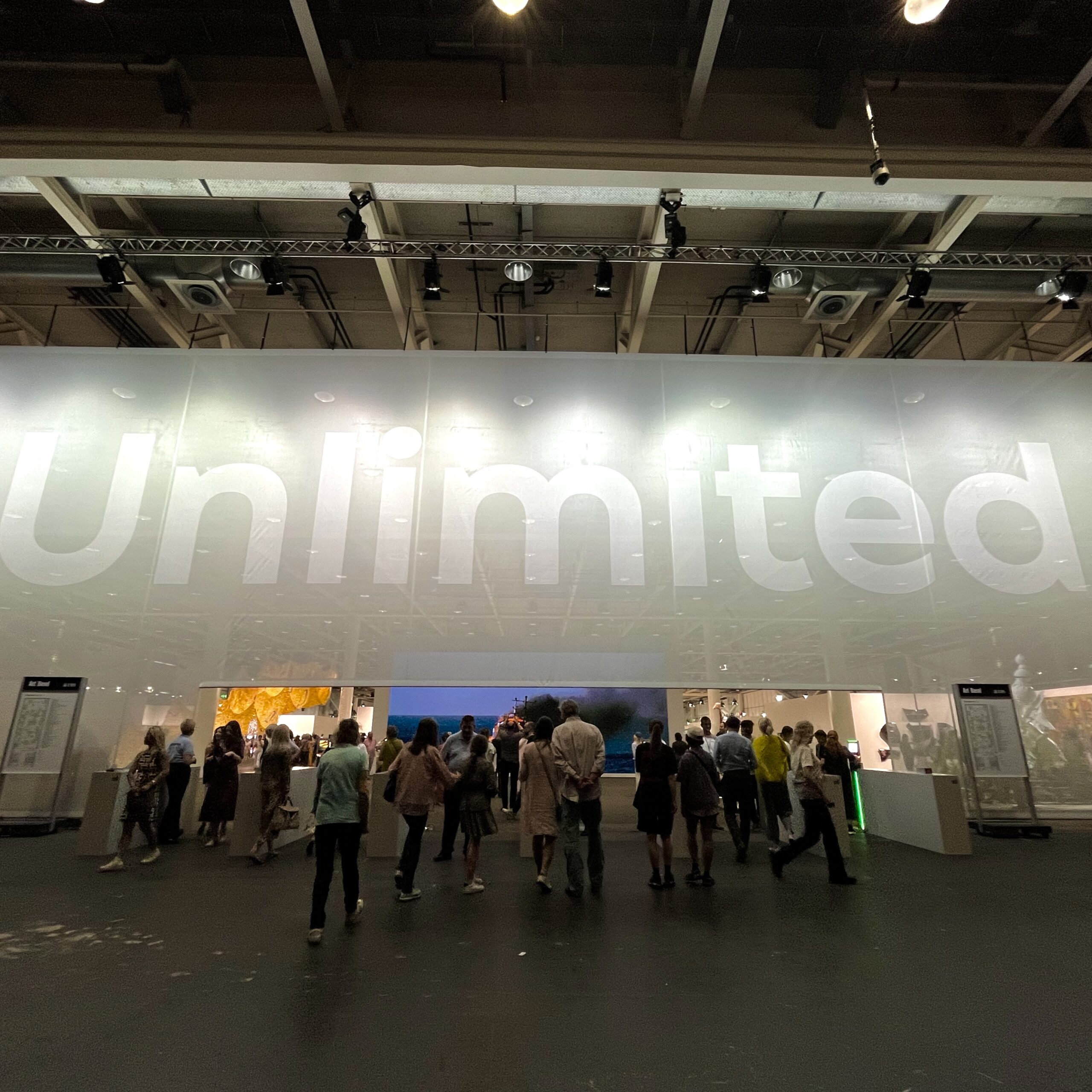
    A must-see section is Unlimited, which focuses on curated, large-scale installations that will otherwise look out of place in a typical gallery display. It is housed in a 16,000 square-meter exhibition space. Unlike the Galleries sector, which is laid out as a series of booths with changing displays, Unlimited invites viewers to interact not just with the work but the physicality of the space. Monumental sculptures, live performances, larger-than-life paintings and video projections are just some of the surprises that await fair goers. Curated by Giovanni Carmine, Unlimited this year featured 76 artworks by emerging and named artists from across the world. Themes predominantly explored artistic responses to politics, climate change, technology, and major global crises. 

    Malaya del Rosario, art manager based between the Philippines and Switzerland, roamed Unlimited’s grounds and has selected five unforgettable works to discover.

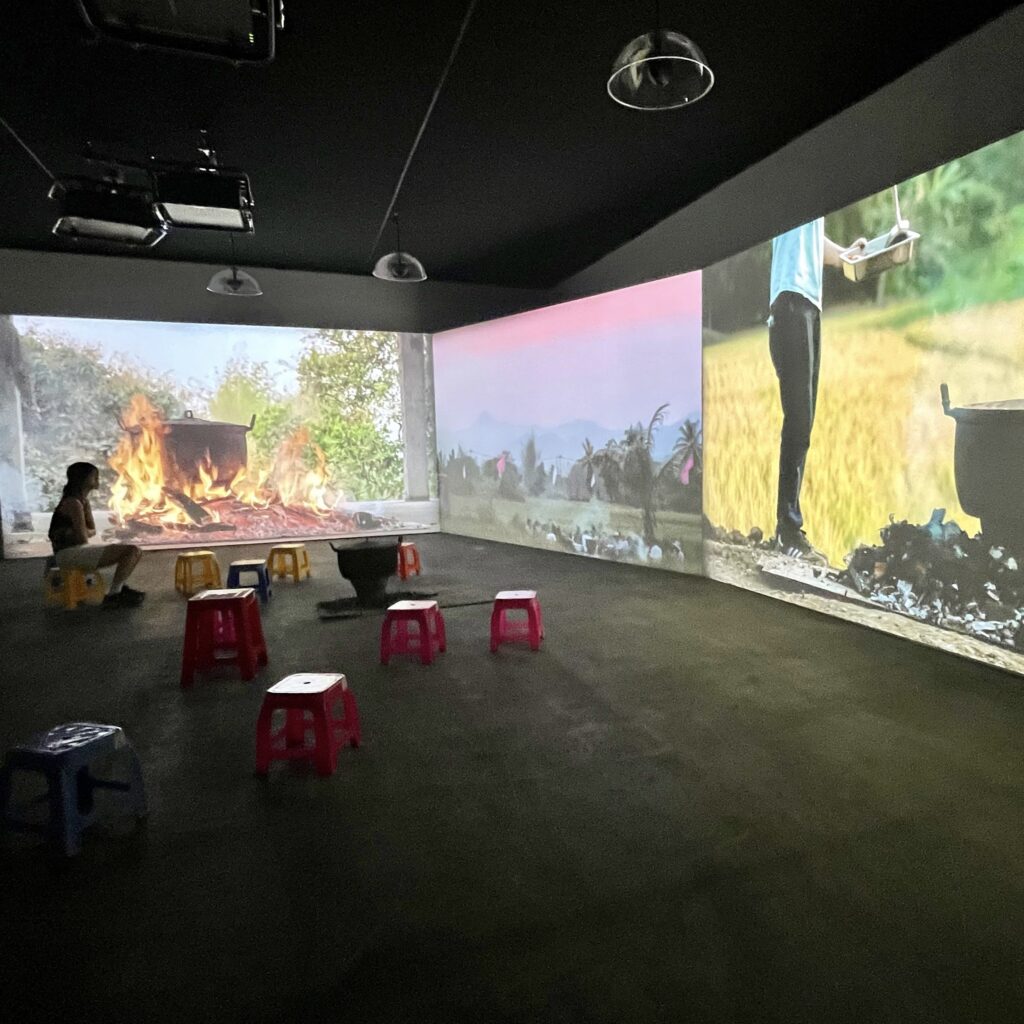
    1. Rirkrit Tiravanija, untitled (curry for the soul of the forgotten) (2015)

    Presented in an enclosed space, Rirkrit Tiravanija’s work features a three-channel video projection as well as actual objects. In front of the screens are low, plastic stools. At the center of the room is a bronze cauldron, a replica of the one in the video, on top of a flattened cardboard. It is meant to feel like someone is in the middle of cooking a meal on an open fire. 

    Tiravanija is known for combining film, readymade and performance in his practice. Food, and specifically, Thai cuisine, is a long-standing component in his works, often symbolising community, gathering, and the everyday. An earlier work from 1992 saw the artist feeding curry to visitors in a New York gallery as a performative piece.

    In this particular work, the artist wanted to pay tribute to ‘the forgotten,’ presumably the political activists fighting for democracy, through food. Shot in Thailand,  the film documents the ritual of cooking curry to highlight “the often-forgotten agents of social and political change in protests both domestically and around the world.” Interacting with this work in a three-dimensional setting is like being transported to a street kitchen that would feel very familiar to someone coming from Southeast Asia.

    1. Wu Chi-Tsung, Dust 002 (2023)

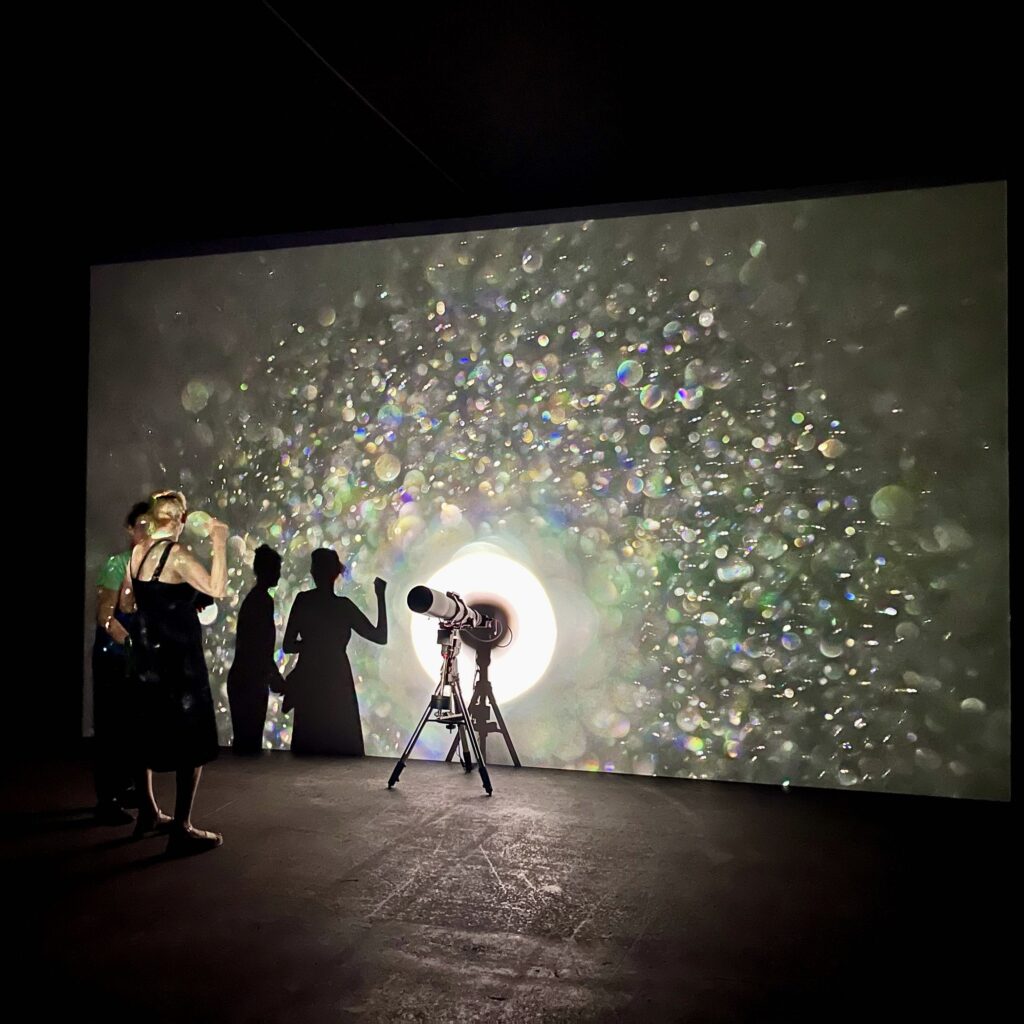
    Taipei-born, Wu Chi-Tsung, is very much interested in how we see the world through media and how our perceptions are easily altered by technology. The installation, Dust 002, consists primarily of a telescope, video camera and projector. Entering a darkened room, the viewer’s gaze is drawn to the telescope facing a wall, a halo around it, and fluttering specks of light. The movement is caused by magnified particles in the air, as activated by the viewers’ movements inside the room. 

    The combination of optical tricks, technology and chance is quite smart, and the result is a highly aesthetic and poetic experience for the viewer.  It demonstrates how we can so easily and inevitably impact our environment without realizing it. To fully appreciate the artwork means to take one’s time in observing the elements and delicate motions in the space.

    1. Mika Tajima, You Be My Body for Me (2023)

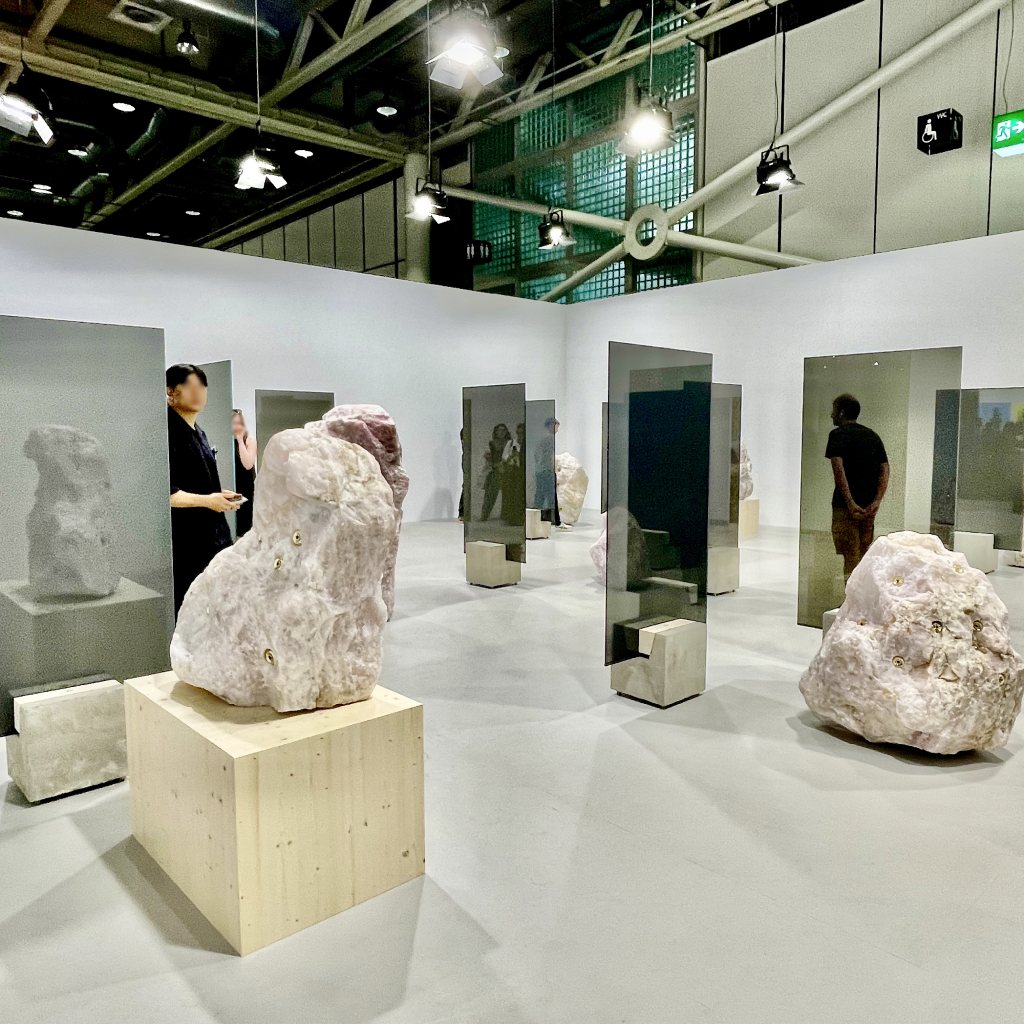
    Los-Angelos born Mika Tajima’s practice is driven by an inquiry into how technology and virtual spaces transform bodily and physical experiences into new forms. Interacting with Tajima’s work, Be My Body for Me, feels like walking through a rock garden, in which large, rose quartz sculptures are positioned alongside freestanding ‘smart glass’ panes. As the viewer moves around, the glass panes change opacity through electric charges. While these changes seem random, the glass panes are in fact connected to a digital algorithm. 

    The rose quartz, on the other hand, pinkish and massive, seems to represent human torsos. Upon closer inspection, one will notice holes cutting through the sculptures, acting as pressure point openings. Tajima’s choice to use this material is due to its inherent technological capabilities. “The punctured diagram of acupuncture pressure points on rose quartz brings together ancient materials, techniques, and the enigmatic symbols of human energy, life, and the urge to control the unknowable,” explains Tajima. 

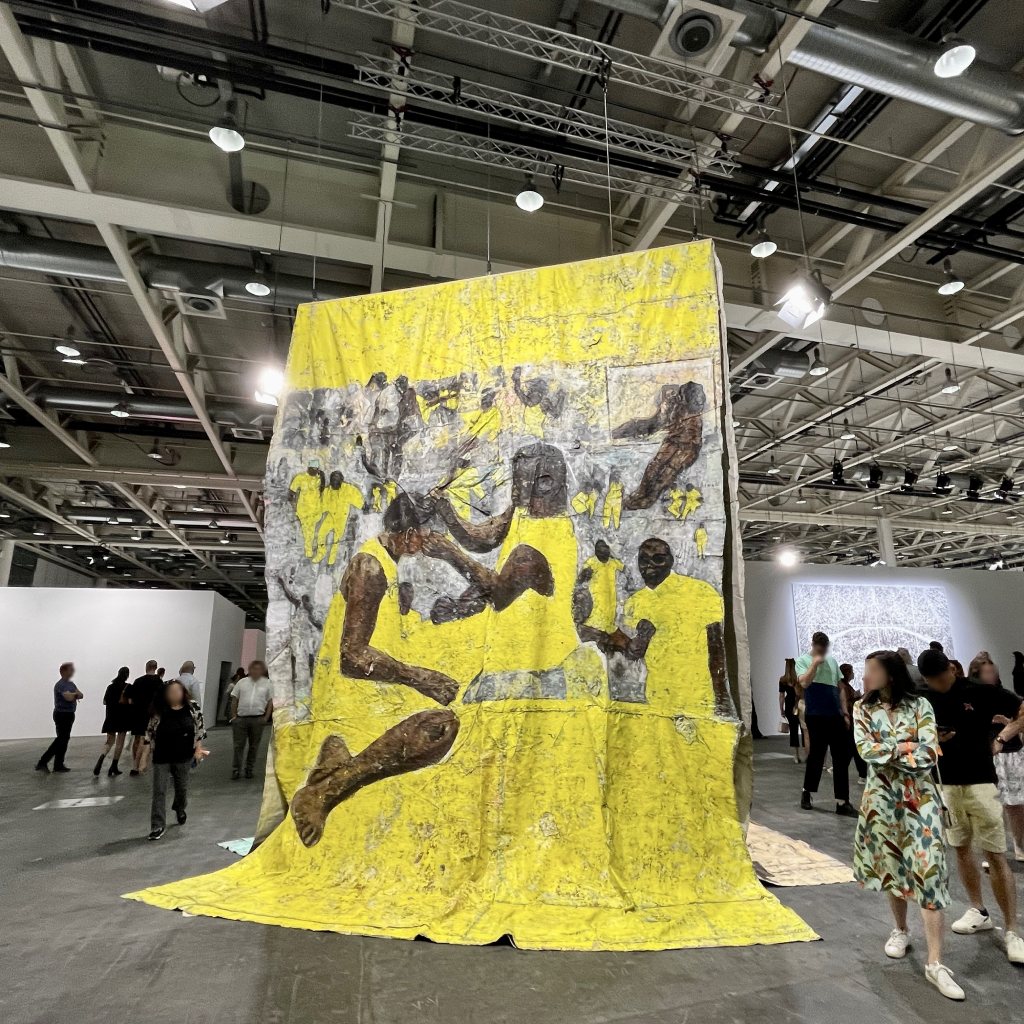
    1. Kaloki Nyamai, Dining in Chaos (2023)

    Kaloki Nyamai’s triptych of gigantic paintings are hard to miss. Hanging gracefully as unstretched pieces of canvas across the monumental exhibition hall, they powerfully represent Nyamai’s interest in painting as a sculptural medium. Depicting vignettes taken from the artist’s Kenyan heritage, they are unforgettable not only for their scale but their bright colours and eye-catching imagery. 

    Using acrylic, sisal rope, and dye transfer on paper over canvas, all three paintings show human figures doing seemingly leisurely activities against a backdrop of social unrest. Despite this context, the paintings successfully depict a beautiful kind of chaos – organic, textured, contrasting, full of movement. 

    Referring to the title, ‘Dining in Chaos’ the artwork asks a simple yet provocative question: When a major disruption occurs, “does one stop abruptly, or carry on dining?” 

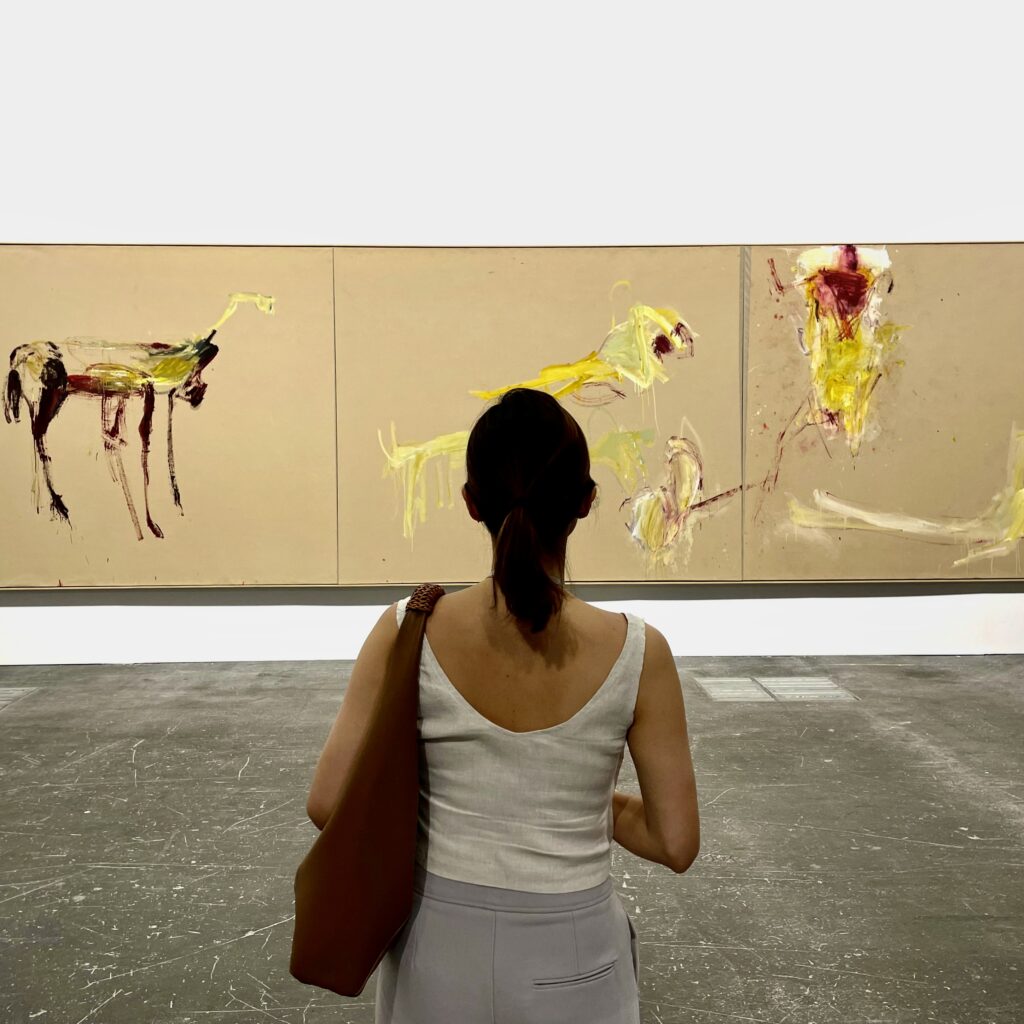
    1. Martha Jungwirth’s Memorial II (Triptychon) (2021)

    Martha Jungwirth’s work, Memorial II (Triptychon), is a nearly nine-meter-long frieze-like painting. Made up of oil on paper on canvas, it features animal-like elements painted through rapid paint brushstrokes. The three-part image is mostly sparse, raw and unprimed, making the figures look like they are floating in space.  

    The work is inspired by animals affected by modern environmental disasters and sculpted creatures found in ‘King Tut’s (Tutankahmun’s) tomb in Egypt a century ago. Looking through this long canvas, the painting acts like a window to the past. It portrays a lone creature on the left panel contemplating its uncertain destiny, while streaks elsewhere suggest exposed ribcages or animals’ wiry legs. Jungwirth’s expressive and poetic approach seamlessly connects ancient civilizations to contemporary environmental issues and eternal life and death questions. 

    Born in 1940 Vienna, Jungwirth has developed a unique abstraction grounded in observation and the body. Her work spans over six decades, occupying an intuitive space beyond spoken language and object obtrusiveness. 

    With so many high-impact artworks, Unlimited has proven to be the pulse for global art trends and an excellent platform for artists we need to know now.

  • Interview on Living in Switzerland podcast

    Interview on Living in Switzerland podcast

    On December 8, 2023 I was featured in an interview conducted with Kathrin Spinnler for Rigby AG and their podcast series Living in Switzerland.

    The podcast is called The Swiss Art Scene with Nikolai Kleist Burkal can be found here. (available on various podcast platforms)

    The series aims to provide information about various aspects of moving to and living in Switzerland for both a new and residing audience, and for foreigners and Swiss alike.

    In the podcast I am asked to talk about my practice as an artist, my background and living in the Philippines, as well as the approach the Swiss art scene. I try to give an overview of the the various art venues and institutions across the big cities in Switzerland, how to approach art scenes as an artist, and advice on how to develop and expand your options as an artist in Switzerland.

    The interview captures very well what I want to achieve with Art-Beats, to investigate current topics in art, document art scenes, share perspectives on art, and ideally engage a new audience.

    Please have a listen at the podcast, and I hope you enjoy it.