
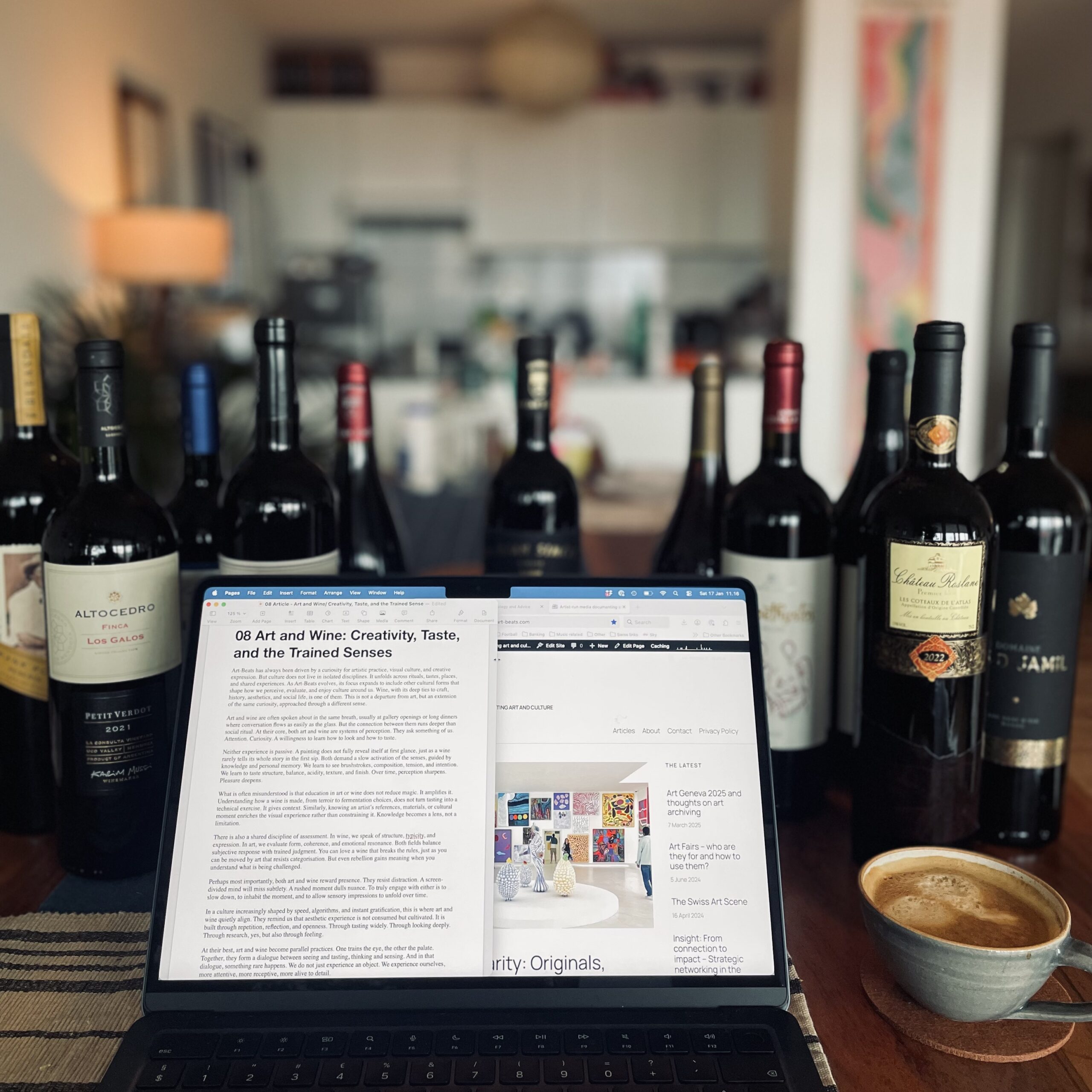
Since its launch, Art-Beats has been driven by a curiosity for artistic practice, visual arts, and cultural expression. But cultural disciplines do not exist in isolation. They are expressions of a shared cultural fabric, shaped by overlapping histories, practices, and ways of sensing the world. Culture unfolds across rituals, tastes, places, and shared experiences.
As Art-Beats evolves, its focus aims to expand to include other cultural forms that shape how we perceive, evaluate, and enjoy the world around us. Wine, with its deep ties to craft, history, place, and social life, is one of them. This is not a departure from art coverage, but an extension of the same curiosity, approached through different sensory experiences.
A Shared Cultural History: Art and Wine in Dialogue

The relationship between art and wine is also deeply embedded in cultural history. Wine has been a recurring subject in fine art for centuries, from Caravaggio’s Bacchus to the convivial scenes of Dutch Golden Age still life paintings or vanitas, where wine symbolised abundance, indulgence, and moral tension, like the fleeting nature of earthly pleasures and worldly pursuits.
In contemporary culture, the dialogue between art and wine has become increasingly deliberate and conceptually rich. One of the most enduring examples is Château Mouton Rothschild, which since 1945 has commissioned leading artists to design its annual labels, including Pablo Picasso, Andy Warhol, and Gerhard Richter. These wine labels have become cultural markers, embedding each vintage within the artistic language of its time and transforming the bottle into a collectible object that carries both aesthetic and historical value.

More recently, artists have begun to engage with wine not only as surface but as form and narrative. Daniel Arsham’s reinterpretation of the Moët Impérial bottle, rendered as a futuristic archaeological artefact, repositions the champagne as an object suspended between past and future, consumption and preservation. The work echoes Arsham’s broader practice of imagining contemporary objects as relics, and in doing so, invites reflection on how cultural value is constructed and remembered.
Beyond high-profile collaborations, a growing number of producers are embracing art-inspired labels and artist partnerships as a way of articulating identity, place, and philosophy. In these cases, visual language becomes a means of storytelling, offering an entry point into the wine’s origin, values, and sensibility.
Passion Assets, Perception, and Experience

Art and wine are often spoken about in the same breath, usually at gallery openings or long dinners where conversation flows as easily as the glass. In financial portfolio management, as defined by the CFA Institute, they are even considered part of the same asset class, categorised as passion assets or collectibles. But the connection between them runs deeper than social ritual. At their core, both art and wine are assessed through systems of perception. They encourage engagement. Demand attention. Evoke curiosity. A willingness to learn how to look and how to taste. And perhaps most importantly, both art and wine reward presence.
Neither experience is passive. An artwork does not always reveal itself at first glance, just as a wine rarely tells its whole story in the first sip. Both often require a slow activation of the senses, guided by knowledge and personal experience. By intentionally looking, we learn to see brushstrokes, composition, expression, and intention behind an artwork. Sip by sip, we learn to taste structure, balance, acidity, texture, and finish of a wine. Over time, our perception sharpens. Pleasure and appreciation deepens.
Assessment, Criticism, and Contemporary Pressures
There is also a shared discipline of assessment. In wine, we speak of structure, typicity, and expression. In art, we evaluate form, coherence, and emotional resonance. Both fields balance subjective response with trained judgement. You can love a wine that breaks the rules, just as you can be moved by art that resists categorisation or conventions. But even rebellion gains meaning when you understand what is being challenged.
Both art and wine are also shaped by ongoing criticism, debate, and shifting evaluative frameworks. In wine, discussions increasingly centre on how climate change is altering traditional styles and regional identities, how producers respond to evolving consumer expectations around sustainability and moderation, and how economic pressures affect production and distribution. These debates challenge long-held notions of typicity and quality, prompting producers and critics alike to reconsider what excellence looks like in a changing world.
In the art world, assessment is similarly influenced by broader cultural and structural pressures. Questions of access, visibility, and economic sustainability continue to shape artistic practice, alongside debates about how digital platforms, institutional gatekeeping, and global audiences redefine value and authorship. At the same time, artists are navigating expectations around authenticity, social relevance, and cultural responsibility, often working across disciplines and formats that resist traditional modes of critique. In both fields, judgement is no longer fixed but negotiated, reflecting a cultural landscape in flux.
Final Thoughts
In a culture increasingly shaped by speed, algorithms, and instant gratification, this is where art and wine quietly align. They remind us that aesthetic experience is not consumed but cultivated. It is built through repetition, reflection, and openness. Through tasting widely. Through looking closely. Through research and experience, yes, but also through feeling and sensing.
Further Reading & Sources:
- CFA Institute – Investing in Fine Wine and Passion Assets Overview of fine wine and art as alternative investment categories
- International Adviser – Passion Assets and Tax Considerations Discussion of collectibles, including art and wine, within private wealth and taxation contexts
- Caravaggio, Bacchus (1598), Uffizi Gallery One of the most iconic representations of wine in Western art history
- Château Mouton Rothschild – Artists’ Labels Documentation of the estate’s long-running collaboration with contemporary artists
- Daniel Arsham x Moët & Chandon Overview of Arsham’s reinterpretation of the Moët Impérial bottle as a conceptual artwork
- The Collector – Vanitas: Dutch Master Paintings Explained A walkthrough of 17th century Dutch still life paintings and their symbolic compositions