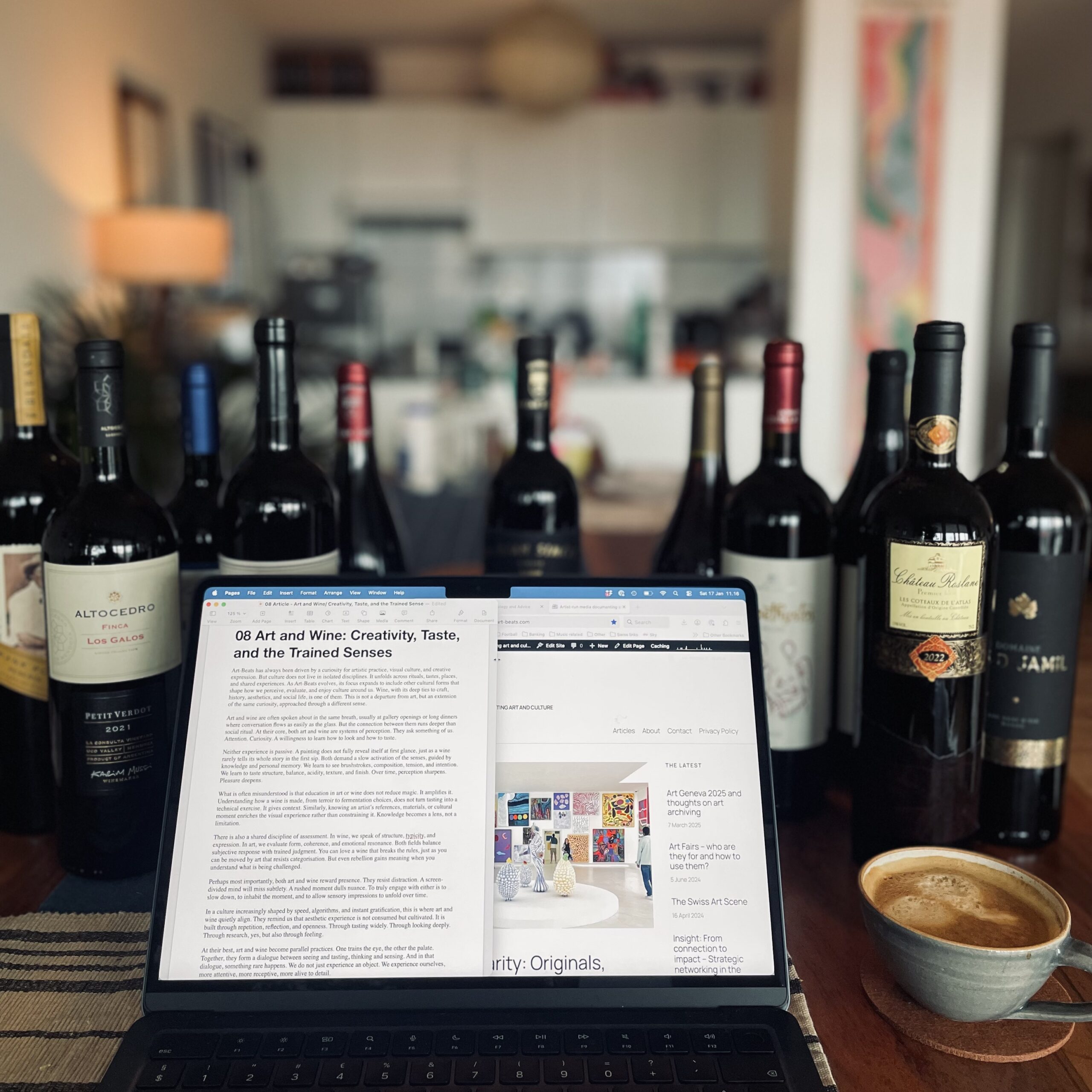
Since its launch, Art-Beats has been driven by a curiosity for artistic practice, visual arts, and cultural expression. But cultural disciplines do not exist in isolation. They are expressions of a shared cultural fabric, shaped by overlapping histories, practices, and ways of sensing the world. Culture unfolds across rituals, tastes, places, and shared experiences.
As Art-Beats evolves, its focus aims to expand to include other cultural forms that shape how we perceive, evaluate, and enjoy the world around us. Wine, with its deep ties to craft, history, place, and social life, is one of them. This is not a departure from art coverage, but an extension of the same curiosity, approached through different sensory experiences.
A Shared Cultural History: Art and Wine in Dialogue
The relationship between art and wine is also deeply embedded in cultural history. Wine has been a recurring subject in fine art for centuries, from Caravaggio’s Bacchus to the convivial scenes of Dutch Golden Age still life paintings or vanitas, where wine symbolised abundance, indulgence, and moral tension, like the fleeting nature of earthly pleasures and worldly pursuits.
In contemporary culture, the dialogue between art and wine has become increasingly deliberate and conceptually rich. One of the most enduring examples is Château Mouton Rothschild, which since 1945 has commissioned leading artists to design its annual labels, including Pablo Picasso, Andy Warhol, and Gerhard Richter. These wine labels have become cultural markers, embedding each vintage within the artistic language of its time and transforming the bottle into a collectible object that carries both aesthetic and historical value.
Pieter Claesz, Still Life with Herring, Wine and Bread (1647). Los Angeles County Museum of Art, Los Angeles.
More recently, artists have begun to engage with wine not only as surface but as form and narrative. Daniel Arsham’s reinterpretation of the Moët Impérial bottle, rendered as a futuristic archaeological artefact, repositions the champagne as an object suspended between past and future, consumption and preservation. The work echoes Arsham’s broader practice of imagining contemporary objects as relics, and in doing so, invites reflection on how cultural value is constructed and remembered.
Beyond high-profile collaborations, a growing number of producers are embracing art-inspired labels and artist partnerships as a way of articulating identity, place, and philosophy. In these cases, visual language becomes a means of storytelling, offering an entry point into the wine’s origin, values, and sensibility.
Passion Assets, Perception, and Experience
Luxury wines, some with hand-painted labels displayed at Tenuta Torciano Winery in Tuscany, Italy
Art and wine are often spoken about in the same breath, usually at gallery openings or long dinners where conversation flows as easily as the glass. In financial portfolio management, as defined by the CFA Institute, they are even considered part of the same asset class, categorised as passion assets or collectibles. But the connection between them runs deeper than social ritual. At their core, both art and wine are assessed through systems of perception. They encourage engagement. Demand attention. Evoke curiosity. A willingness to learn how to look and how to taste. And perhaps most importantly, both art and wine reward presence.
Neither experience is passive. An artwork does not always reveal itself at first glance, just as a wine rarely tells its whole story in the first sip. Both often require a slow activation of the senses, guided by knowledge and personal experience. By intentionally looking, we learn to see brushstrokes, composition, expression, and intention behind an artwork. Sip by sip, we learn to taste structure, balance, acidity, texture, and finish of a wine. Over time, our perception sharpens. Pleasure and appreciation deepens.
Assessment, Criticism, and Contemporary Pressures
There is also a shared discipline of assessment. In wine, we speak of structure, typicity, and expression. In art, we evaluate form, coherence, and emotional resonance. Both fields balance subjective response with trained judgement. You can love a wine that breaks the rules, just as you can be moved by art that resists categorisation or conventions. But even rebellion gains meaning when you understand what is being challenged. Both art and wine are also shaped by ongoing criticism, debate, and shifting evaluative frameworks. In wine, discussions increasingly centre on how climate change is altering traditional styles and regional identities, how producers respond to evolving consumer expectations around sustainability and moderation, and how economic pressures affect production and distribution. These debates challenge long-held notions of typicity and quality, prompting producers and critics alike to reconsider what excellence looks like in a changing world.
In the art world, assessment is similarly influenced by broader cultural and structural pressures. Questions of access, visibility, and economic sustainability continue to shape artistic practice, alongside debates about how digital platforms, institutional gatekeeping, and global audiences redefine value and authorship. At the same time, artists are navigating expectations around authenticity, social relevance, and cultural responsibility, often working across disciplines and formats that resist traditional modes of critique. In both fields, judgement is no longer fixed but negotiated, reflecting a cultural landscape in flux.
Final Thoughts
In a culture increasingly shaped by speed, algorithms, and instant gratification, this is where art and wine quietly align. They remind us that aesthetic experience is not consumed but cultivated. It is built through repetition, reflection, and openness. Through tasting widely. Through looking closely. Through research and experience, yes, but also through feeling and sensing.
Throughout art history art criticism has contributed greatly to discussions and understanding of art. Criticism has played a key role in the sense-making of art by offering a personal assessment of artworks, while bridging the gap of understanding from artwork to audience.
I picked up this topic for two reasons. Firstly, I was interested in knowing how the role of the art critic has changed over time. And secondly, I realised I couldn’t remember the last time I actually read a review of a current show. I have been studying, working, and have even been writing about art for a while, but somehow I find myself spending little time on art reviews. In my mind, I should be the perfect audience for it. So, am I just lazy or is there something wrong in the world of art criticism that I have missed (read: one statement does not exclude the other).
My previous understanding of the art critic’s role was linked to the effort of acknowledging and legitimising artist’s work. A good review can help an artist make a name for him/herself, while a bad review could set back an artist’s career. This seems pretty straight forward in earlier times where reviewers had a good overview of how many artists were represented in an art scene or movement, but a bit more complex in contemporary art where you have not only a huge variety of styles, mediums, and cultures represented, you also have vast amount of distribution channels with a constant flow content being added (especially via social media).
To gain a little more perspective on art criticism today, I have been diving into dusty history books to look for key people and events that have helped in shaping art criticism as a term and profession. Basically, I have been looking for the distinction between art history and art criticism.
Art has changed considerably over time, both in terms of creating, studying, and experiencing art. This makes me wonder how art criticism has also changed along with changing art practices, and what challenges the field of art criticism is facing today.
Through these questions and in reviewing the history of art criticism, I would like to use this research to understand the need and potential of art criticism today.
Criticism in the history of art
I have always found it interesting to go back in time to see how ideas were formed, and how they have evolved over time into something we might consider well-established components of our society and culture today. I like to keep in mind, that every current tradition was once created by someone.
Photo: The Thorvaldsen Museum Copenhagen, 2016
So, do allow me to skip into the history books a little, to browse through the past valuable writings of the Roman writer Pliny the Elder, whose descriptions of art in the Natural History (around AD 70) include some of the earliest writings on describing art; of the Chinese writer and historian Xie He’s Six Principles of Chinese Painting (6th century AD), which were established to assess the quality of paintings; even browsing past the essential writings of Italian artist-writer Giorgio Vasari, who authored Lives of the Most Excellent Painters, Sculptors, and Architects (1550), which laid out an important foundation for art writing by including the artists’ biographies. This is just to say that, many important writings on art can be traced far back to both Western and Eastern history, but in the case of art criticism, we will have to pick up from when the term became a distinct genre of its own.
Which leads us to Jonathan Richardson’s An Essay on the Whole Art of Criticism (1719) when the term art criticism was first used. Richardson’s works both encouraged young men to embark on the cultural pilgrimage the Grand Tour, which became popular at the time, as well as provided a basis for British collectors to get interested in art, as he attempted to objectively rank the quality of paintings on a scale of 0-18. It is hard to imagine such a practice being embraced today, but at the time, Richardson’s approach helped to engage the British middle-class in art by providing a method for asserting one’s taste.
Art criticism was thus born, and a popularised method for judging the quality of art was thus established.
French enlightenment writer Dennis Diderot later contributed greatly to the language of artcriticism with his reports on the salons in Paris between 1759-1781. Diderot’s contributions were published in the newsletter La Correspondance primarily for the European elite, which greatly appreciated his new ways of describing art. Because his readership consisted of a smaller and more exclusive group, Diderot was able to write more freely and avoid strict censorship. With Diderot, a new generation of writers flourished who sought to make a living of art criticism and writing.
Art criticism became a profession and free expression became an essential part of the style of writing.
In the 19th century, Victorian writer John Ruskin made a name for himself when he famously defended William Turner in his Modern Painters (1843). Ruskin brought forth romantic theory and scientific analysis to prove Turner’s critics wrong. However, an artist who received less praise and appreciation from Ruskin was J.M. Whistler. Ruskin allegedly published a letter in 1877 wherein he bashed Whistler’s work Nocturne in Black and Gold in harsh terms, for lacking a moral and didactic purpose. Whistler sued Ruskin for libel and actually won the case, but went bankrupt after the case ended. To make things worse, during the trial the Nocturne painting was apparently brought into the courtroom upside down and was further ridiculed in the press. Professionally, they both suffered from that court case.
Art criticism became a way of justifying style and expression in support of the artists. What Ruskin brought to the table was really the use of theory and scientific analysis, which became great compliments to art assessment. Ironically, Ruskin also demonstrates the damaging effect of bias in criticism, as some historians speculate on Ruskin and Whistler’s differences in political ideology as an explanation for the quarrel between them.
Across the English Channel, French poet Charles Baudelaire had found new ways of critiquing and writing about art in his The Salon of 1845 and 1846 publications. According to Baudelaire, art criticism and writing should be passionate, partial, political, and addressed to the majority – in this context, the middle-class. He urged that criticism should be formed from an exclusive point of view, but in a way that would open up the greatest number of horizons. As was the common practice at the time, Baudelaire would walk through the large salon exhibitions while jotting down phrases or pages of notes for each artist. Like Ruskin, Baudelaire was a product of Romanticism. The late 19th century was a turning point for increased urbanisation. Baudelaire’s views on Romanticism as an expression of pure individuality and emotionality were challenged by the push for a more modern subject matter, thereby paving the way for a new direction in art, towards Realism.
Art criticism became a medium for engaging the wider audience in art, as well as for providing valuable feedback to artists, in other words art criticism had two audiences: the public and the artists. Art criticism also helped predicting the direction of art by tracing trends in society and painting styles.
In the early 20th century art was changing rapidly, with new movements shooting up like mushrooms, so art criticism had to keep up. Bloomsbury Group-member and English writer Roger Fry gained a reputation for his expertise on the Old Masters. However, Fry became an advocate for the new developments in French art, which he famously dubbed as Post-Impressionism. He was fascinated by the trends in modern art, and vigorously defended art based on pure imagination; as opposed to earlier art directions attempting to capture the real and natural. He supported the thoughts of Formalism, which argued that, the most central quality of art is its form, rather than the conventional subject matter. According to Fry, the value of art should therefore be judged on its ability to produce a distinctive aesthetic experience, with the experience representing a so-called aesthetic emotion.
Art criticism not only helped to justify individual artists’ works, but also helped open up whole new movements and new ways of perceiving art.
Mid 20th century art was helped along with critics such as Polish-Italian writer Guillaume Apollinaire and Argentine writer Rafael Squirru, who saw a reoccurrence of the poet-as-critic (like Baudelaire). Apollinaire’s literary contribution helped in defining the aesthetic principles of Cubism as well as of Surrealism, while Squirru contributed greatly to promote Latin American art through the decades. In the US, writers such as Clement Greenberg wrote critical essays published in Art and Culture (1961), and helped create awareness of the emerging American art, particularly in praising Abstract Expressionists Jackson Pollock, Willem de Kooning, Barnett Newman and others in that group.
Art criticism became a channel for representing art in the otherwise marginalised areas of the art world, and basically helped widen the reach of art documentation.
In 1949 the International Association of Art Critics (AICA) was established as an affiliate of UNESCO in order to revitalise critical discourse, which had suffered from fascism throughout the 1930s and 40s. AICA was established to preserve the vocation of art criticism, as well as to analyse its responsibility to artists and the public. According to AICA, its defined objectives included promoting art criticism as a discipline and defending impartial freedom of expression and thought.
Art criticism as a global network was thus established by forming its own international association. AICA became a support system and a forum for art critics to understand their responsibility, as well as to revitalise the profession.
In the 1970s, Feminist art criticism came naturally with the general feminist movement. A new direction of criticism emerged emphasising the under-representation of women in art. American writer Linda Nochlin’s essay Why Have There Been No Great Women Artists? (1971) paved the way for new discussions on the issue. Nochlin brought up issues of societal barriers preventing women from pursuing careers in art. She also criticised previous perspectives on Orientalism for their often erotic or violent themes as reflections of the early 19th century attitudes of chauvinism and misogyny in France.
Art criticism opened up the doors for more inclusivity by questioning previous attitudes in art practice. Despite the refinement of art theories over previous centuries, a critical re-evaluation of fair representation in art history was raised with Feminist art criticism.
Art criticism today – artworks and art-words
This is the part that really intrigues me, the role of art criticism today. Based on the lessons from the above historical walk-through, some aspects of the evolution of art criticism still seem valid today. The audience can be differentiated between two branches; the public and the artists. Different types of art writings seem to serve different purposes – academic art criticism for scientific study and assessment, and popular art criticism for a wider audience. And then, there are the aspects of personal judgement, fairness, and partiality. So, with that in mind, what makes a good critic?
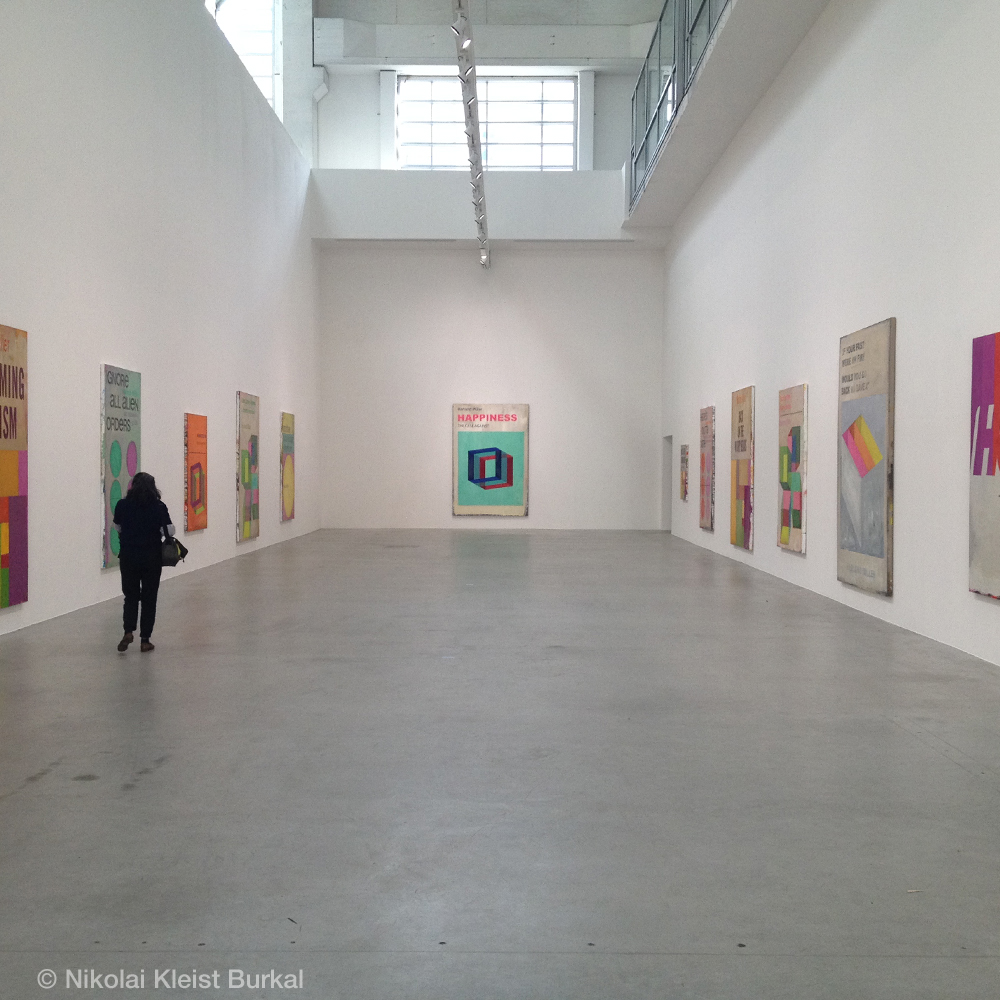
Photo: Harland Miller’s Tonight we make history, Blain & Southern Gallery Berlin, 2016
Gilda Williams’ practical handbook How To Write About Contemporary Art (2014) discusses certain principles worth considering for art critics. According to Williams, art critics lose their credibility if the writing comes off sloppy or somehow marked by favouritism. As a minimum, the critic should disclose any partiality, whether it is writing about a friend, relative, colleague, or the critic’s previous relationship with a given institution or venue. Furthermore, Williams warns readers about seemingly objective art writings from commercial material, such as catalogues from auction houses, galleries, or private collections. However, Williams does note that the traditional image of the art critic as an impartial, incorruptible, and fully independent art explorer is merely a popular myth. Today’s art critic must take upon many roles (researcher, blogger, editor, curator etc.) in order to respond to the demands of art writing, and must master several formats of writing (journal-writing, market news, interviews, academic theory etc.).
Eleni Gemtou, art scholar at the University of Athens, in her Subjectivity in Art History and Art Criticism (2010) points out the overlapping roles of art historians and critics in terms of analysis, comprehension, interpretation, and evaluation. However, Gemtou characterises the art historian as a person taking a more scientific and objective approach to art, while the critic should balance subjectivity with acknowledged artistic values equally. One role complements the other, as the historian lays the foundation for essential evaluation by the critic.
Challenges of art criticism today
It is notable that, as art or painting has been declared dead over and over again (as in the cases such as Paul Delaroche (1839), Marcel Duchamp (1912), and Donald Judd (1976)), art criticism too, has also been declared dead several times. To understand that claim, we would have to investigate the reasoning behind it.
Photo: Carl Andre: Sculpture as Place, 1958–2010, Hamburger Bahnhof Berlin, 2016
Art critic James Elkin’s Art Criticism: Writing Without Readers (2003) raises interesting points by arguing that art criticism is in a worldwide crisis. According to Elkin, the world is experiencing an increasing number of writers, but a decreasing number of them contributing to intellectual debates. Elkin argues that the overproduction of art writings is merely used as a selling point in catalogues of commercial galleries, while relevant articles are drowning in a vast selection of art magazines and online media. Ultimately, this means that, art criticism has reached a point where no one takes it seriously, or even bothers to read it.
In the interview On Time And Spaces For Criticism: An Interview With Thijs Lijster (2015) by Spanish artist-writer Anna Dot, the question “where is art criticism?” rather than “what is art criticism?” is raised. Lijster argues for changing the focus to “where”, as the displacement of criticism has found new channels such as new media, institutions, and professional writings. He points out that, even if we consider traditional art criticism as having a hard time, it does not mean art criticism has ended. The threat to traditional art criticism is connected with how it is bound by time and space. For Lijster, there is a looming threat of art becoming generic, as the borders of history and territory become blurrier. He also describes how the two branches of art criticism are facing challenges, in the sense that, academic art criticism suffers under cutbacks in universities, and popular art criticism suffers under decreased readership.
On the online show Tea At The Beatrice with Glenn O’Brien (June 2016), Glenn O’Brien meets fellow art critic Jerry Salz. In this cosy, slightly dissatisfied-with-everything, but openhearted conversation between the two seasoned art critics O’Brien and Salz, the audience gets valuable insights into the current state of art criticism. They pick up issues such as how one of the largest art magazines, ArtForum, hardly publishes any actual criticism anymore, and the importance of using of plain language in art writing. What is interesting in this conversation is how criticism seems to have been replaced by the art media’s interest in attracting advertisement revenue. Salz mentions the fear of retaliation against art critics from the galleries and institutions if they write bad reviews. However, Salz emphasises that the size of the venue matters, as negative criticism could have devastating impacts on small venues. In his words: “to take a sledgehammer to a small place”. He further argues that art criticism is generally about respect, and you are respecting the art by allowing criticism to play a role. Across the table, O’Brien expresses the state of art criticism with: “I think it is over, because you can’t write a bad review”. They further discuss the issue of art critics collecting art. When asked, O’Brien openly admits he has been buying artworks as he discovered artists, arguing he’s an advocate for the arts rather than a critic. Salz, on the other hand, states that any artwork he and his wife Roberta Smith (also a celebrated art critic) have ever received has been sent back, except works given by close friends.
It is valuable to hear these thoughts and arguments from art critics on the state of art criticism today. There seems to be a consensus that the traditional art critic is no more, but the role has branched out to several fields within art. Platforms for general publications have changed along with critical writings and the readership. This could answer my personal question as to why I no longer see and read any current reviews. They are surely there, but as a reader you’ll have to become a researcher too. So, I sense that, there is a demand for accessibility and sorting out relevant information.
The potential of art criticism today
I find it hard to believe that art criticism is really dying, or is dead, for that matter. Although, as I mentioned in the introduction, I probably fall under the category of people who do not bother to read art reviews. It is definitely not for the lack of interest, but I think that, my personal attitude towards reviews is more linked to a personal relationship to art. My experience of art is a personal thing. I love making the discoveries and assessments on my own. Another valid point, as mentioned by experienced writers on art (O’Brien, Salz, Williams etc.), there seem to be a general problem with the language in current art writings, which probably goes with the commercial demand for art writings (but not criticism).
Photo: Frank Holliday, Partners & Mucciaccia Singapore, 2015
It is hard to disagree with the idea that, the 19th century critic roaming the salons of Paris is no longer among us. If that is what the critics mean by the traditional art critic is dead. I am completely fine with that; it still holds value in a historical context. But I think art criticism offers much more than the personal judgment of shows or artworks, as it provides valuable documentation in itself.
The “make or break” factor of art criticism is interesting though. Salz’s comment: “to take a sledgehammer to a small place”, not only applies to small venues, but to small art scenes as well. Feedback is invaluable at any stage of development, but hammering on something before it gets a change to flourish, is dangerous too. It is a balance worth considering.
I understand the critics’ desire to retain the integrity of professional art criticism. I understand that professional art critics want to maintain both, the principles of “good writing”, as well as that of professional relationships with other art professionals.
In the broadest sense of art writing, anyone can be an art writer. There are countless art events taking place all over the world, and art criticism should play a role in this. For small art scenes, there has to be room for assessment and feedback for the benefit of the public and the artists. In worst cases, we will see developing art scenes with only positive marketing materials available. Catalogues and commercial writings are fine, for they provide the public with general information and they also play a part in documenting events for future use. But one could argue that, good art scenes need good art critics, and for that to sustain, art criticism essentially needs credibility, impartiality, and passion.
Finally, I think we should be careful with the term art world when we are actually talking about the art scene in a country, or even just a particular city. The practices and the level of development are so different across continents and cultures that, it would be a shame to assume we are all facing the same challenges, and thereby try to apply the same solutions.
I absolutely see a value in art criticism for both big and small art scenes today. I believe it should play a role in educating the audience, documenting art events, as well as giving access to art scenes we probably would not be able to reach.
Further Reading – History of Art Criticism
Britannica encyclopedia: Pliny the Elder, Natural History (around AD 70); Xie He Six Principles of Chinese Painting (6th century AD); Dennis Diderot (1713-1784); Guillaume Apollinaire (1880-1918).
Vasari, Giorgio Lives of the Most Excellent Painters, Sculptors, and Architects (1550)
Richardson, Jonathan An Essay on the Whole Art of Criticism as it Relates to Painting and an Argument in Behalf of the Science of a Connoisseur (1719)
Ruskin, John Modern Painters (1843)
Mayne, Jonathan, The Mirror of Art: Critical studies by Charles Baudelaire (1956), Doubleday & Co., New York.
Woolf, Virginia Roger Fry: A Biography (1940), Harcourt, Brace & Co., New York.
Nochlin, Linda essay Why Have There Been No Great Women Artists?, published in Gornick, Vivian Woman in Sexist Society: Studies in Power and Powerlessness (1971), Basic Books, New York.
Further Reading – Contemporary art criticism
Gemtou, Eleni Subjectivity in Art History and Art Criticism (2010), published in Rupkatha Journal, Vol. 2, No. 1, India.
Williams, Gilda How To Write About Contemporary Art (2014), Thames & Hudson, London.
Elkin, James What Happened To Art Criticism? (2003), Prickly Paradigm Press, Chicago.
Dot, Anna interview with Lijster, Thijs – On Time And Spaces For Criticism: An Interview With Thijs Lijster (2015), A*DESK online art magazine (see www.a-desk.org)
Online show Tea At The Beatrice with Glenn O’Brien, episode from June 14th 2016, produced by Made To Measure (M2M).