
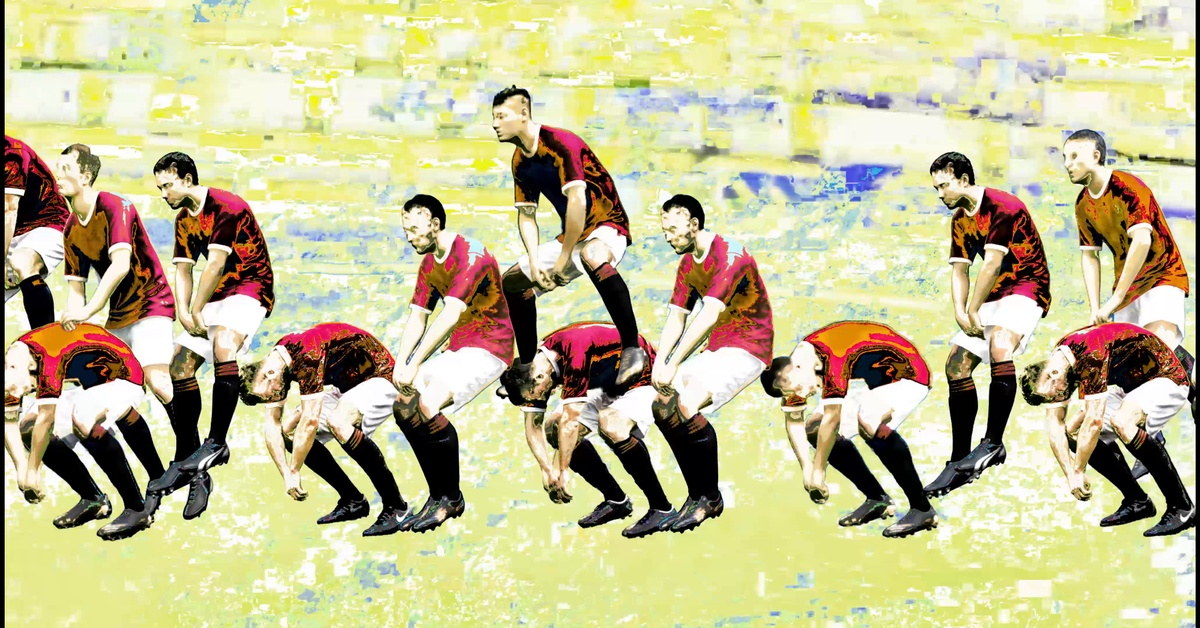
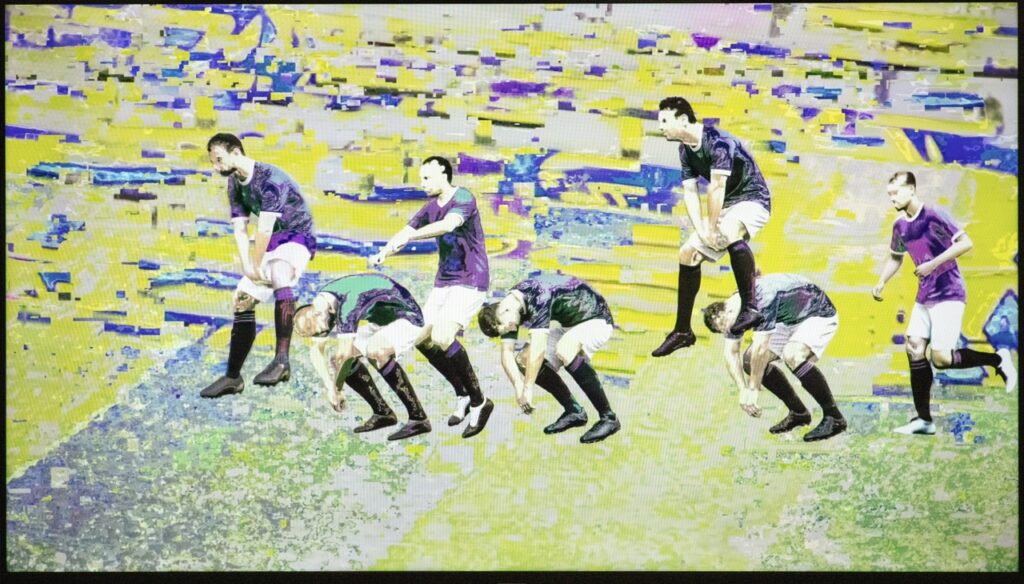
There is a particular kind of image that refuses to sit still in the mind: a leap-frog, suspended mid-jump, caught between the roles of hero and humiliated. Japanese artist and filmmaker Shunsaku Hayashi (b. 1992, Osaka) has built an entire show around it. Hovers, currently on view in Berlin, takes the schoolyard or children’s play, and a borrowed gesture from a football video game, and stretches it into something closer to ritual: a loop of triumph and submission that Hayashi renders across both stop-motion film and five large-format paintings.
Hayashi studied Fine Art at Goldsmiths, University of London, as part of the Japan Cultural Ministry’s Abroad Research Fellowship for emerging artists, and has since built a practice with painting and film at its core. His animated short Interstitial (2017) won the Grand Jury Prize for Animation at Slamdance, and Railment (2017) picked up the Chris Frayne Award for Best Animated Film at the Ann Arbor Film Festival. The two media inform each other at every stage of his process where the paintings in Hovers aren’t storyboards or documentation of the film; they carry their own weight, looking, like ancient frescoes or hyper modern wall paintings waiting to be excavated centuries from now.
Art-Beats asked Hayashi about his move to Berlin, how he has experienced working in Europe compared to Japan, and how a brief moment in a football video game became the starting point for an entire body of work.

From Osaka to Goldsmiths to Berlin
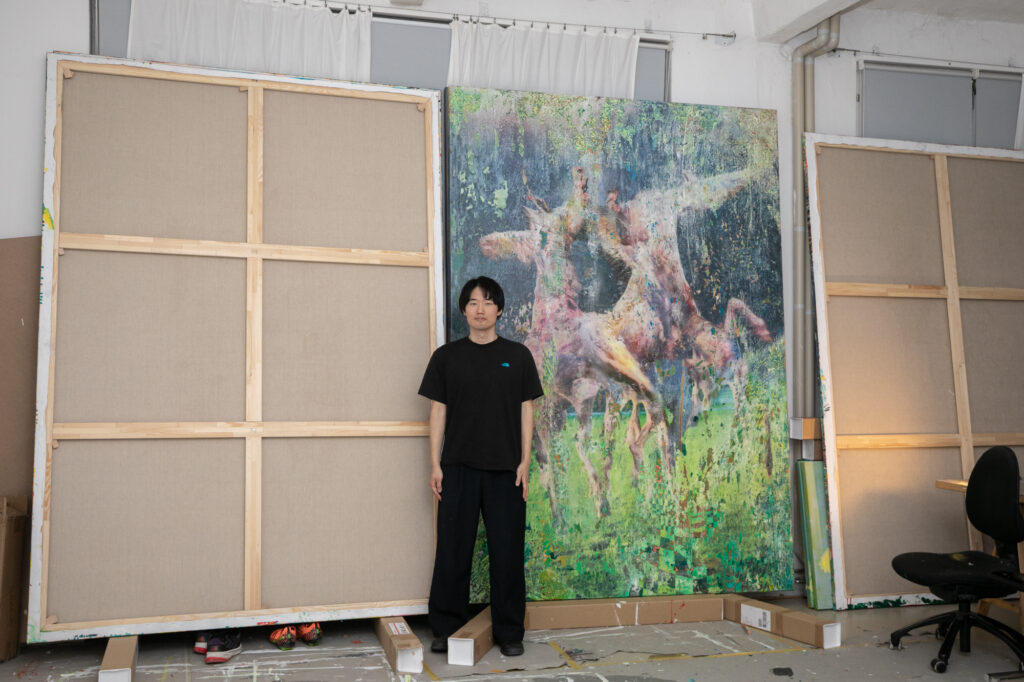
Hayashi’s path to Berlin was neither direct nor planned. After Goldsmiths, he returned to Japan and spent years developing his practice. Still primarily focusing on painting, but increasingly entangled with experimental film and animation, a medium he had explored since childhood. His films traveled the international festival circuit while he remained based in Japan, working on a feature-length project that would take five years to complete.
Completing that film became a turning point. “I decided to move abroad again, create paintings and moving-image works from the ground up in a new place, and present them where they had been made,” he explains. Berlin offered that. A city where, as he puts it, something is happening almost every day, whether an exhibition, a performance, or a music event, and where encountering other people’s work sits naturally alongside making your own. He is currently an artist-in-residence at Künstlerhaus Bethanien, working in the largest studio space he has ever had.
The city hasn’t fundamentally changed how he works, he is careful to say, but it has allowed him to push a practice already in motion much further. And something has shifted emotionally. “The anxiety and sense of urgency that I carried while living in Japan suddenly began to feel much less important after I came to Berlin,” he says. Not because the problems disappeared, but because they shrank. “I now feel as though my life has begun to move forward and is gradually gaining momentum.” It is a quiet admission from someone whose work is anything but quiet, and it gives Hovers, made in this new phase, a particular quality of release.
The Gesture That Stayed
Several years ago, Hayashi caught a glimpse of something in a football video game: a brief goal celebration, a leap-frog, gone almost before it registered. It stayed with him. “I began to wonder what it would mean if this brief gesture continued looping indefinitely and the match never restarted,” he says. That question became the seed of the whole project.
Some celebrations interested him more than others, but this gesture stayed with him. It carried a nostalgic echo of childhood play while also containing what he describes as an interesting conceptual structure: the roles of jumper and supporter continuously alternate, and through that repetition, the group moves forward. Neither role is fixed. Neither body is in charge.
From there, Hayashi dug into the relationship between sport, society, and politics — reading about football in wartime Europe, Japanese baseball biographies, histories of specific clubs, and accounts of how football first arrived in Japan. What he found was a tension he recognised: the sporting body is trained and controlled in pursuit of victory, but inside that discipline, moments of play and accident keep breaking through. “Even amid seriousness, moments of humour can emerge, while something that begins as play can suddenly become serious or even violent,” he says. The leap-frog sits precisely in that unstable space. By engaging in a gesture with no direct relationship to winning, the body briefly steps outside its own prescribed logic, not free exactly, but looser for a moment.
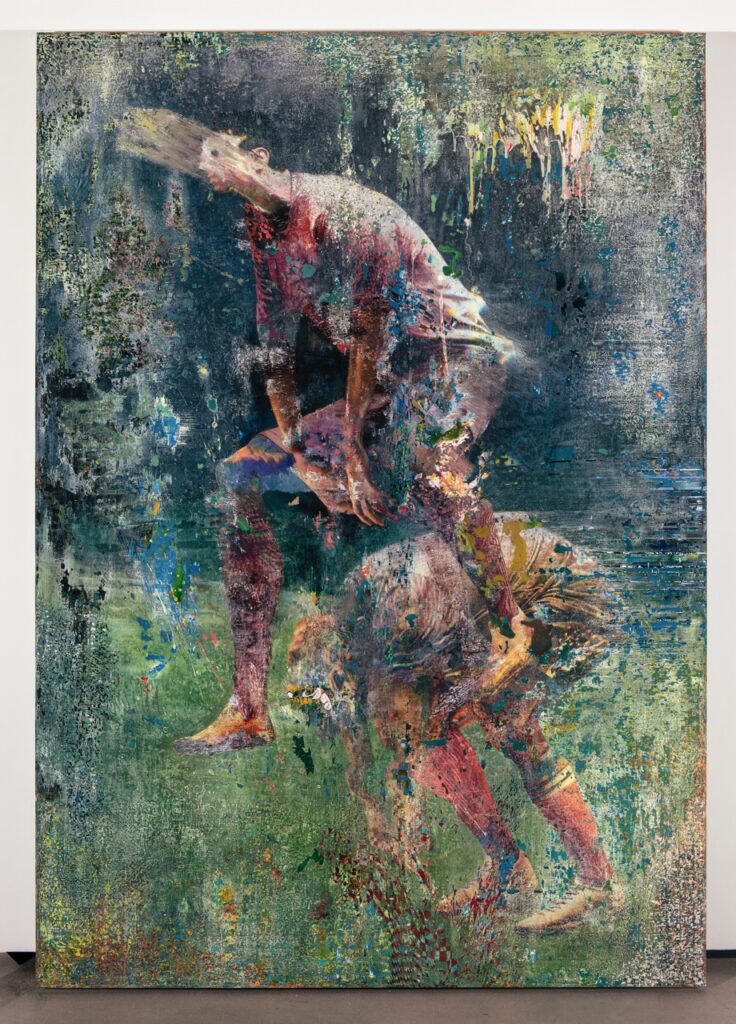
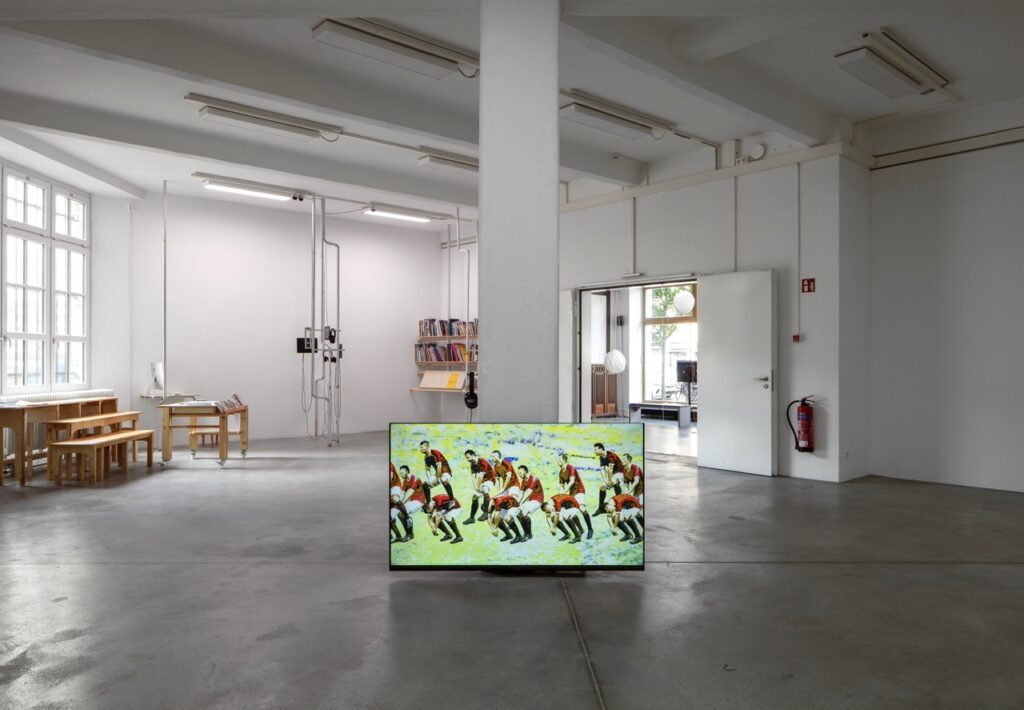
In the exhibition, this plays out across five large-format paintings and a single-channel film. The paintings depict the individual phases of a leap-frog from right to left, grounded and overpainted in elaborate, many-layered detail. Hayashi searches within the buildup of paint for what he calls attractive concealed or coincidentally occurring formations, illusions of digital artefacts blending with complex systems of brushstrokes, glowing colours scattering against dark backgrounds. They look historicised, as though they belong to a time that hasn’t arrived yet. The film accompanies them: stop-motion animation drawn from the paintings, an oscillating electronic soundtrack, and the players leaving the stadium, the game abandoned behind them.
Painting as Time, Film as Material
The relationship between the two media in Hayashi’s work is not one of illustration or documentation. It is more genuinely reciprocal than that, and understanding it is key to understanding why his work holds together the way it does.
“In my practice, painting and moving image are not made separately,” he explains. “I develop them simultaneously, moving back and forth between the two processes so that each can influence and transform the other. Sometimes I destroy what may already appear to be a finished painting in order to create a scene for the moving image. At other times, an unexpected development within a painting changes the narrative or structure of the film.” The painter and the filmmaker in him, he says, are always in dialogue.
What draws him to stop-motion specifically is the way movement in the film leaves traces in the painting, layers of paint that carry the memory of motion, time made material. “What appears as time in the moving image becomes material in the painting.” That equation works in reverse too: the painting slows the film down, gives it mass, keeps it from floating free of the physical world.
This has direct implications for how he thinks about digital tools and AI. He is not dismissive of them, but rather interested in digital textures, in the quality that compression and noise and missing information produce, and in the friction that occurs when analogue and digital materials meet but don’t fully merge. What doesn’t interest him is seamlessness. “I am not particularly interested in AI or digital tools when they are used simply to make everything appear seamless and smooth,” he says. “Every medium has its strengths and limitations. Its limitations can become part of what makes it distinctive.” The question he asks of any technology is not whether to accept or reject it, but what kinds of time and texture it produces, and what might become invisible in the process.
Seeing and Not Seeing
In our exchange, Hayashi shared something that reframes much of what comes before it. He previously underwent surgery for a retinal detachment, and the lower half of the visual field in one eye is still missing. The experience prompted a question that has run through his work ever since: what are my eyes actually seeing? Is the world I believe I am seeing really there?
That uncertainty about perception has resurfaced across his filmography. In Interstitial, he was working with the moving spotlight theory of time, the idea that past, present, and future all exist while the present moves along the timeline like a spotlight, and built a work in which all moments coexisted on a single ten-metre canvas while appearing sequentially in the film. Earlier work like Invisions (2025) approached perception from a more personal angle, grounded in how the world appears through his own damaged, adaptive eye.
With Hovers, he feels he has moved outward. “I have moved away from a perspective centred on myself,” he says. The exchange between jumper and supporter has shifted his attention from individual perception to the way multiple bodies connect, separate, and enable each other to move. The retinal absence that once turned his gaze inward has become, in this work, a lens trained outward — on the collective body, on the group departing the stadium, on what it might mean to move otherwise.
It is a natural evolution, and it makes Hovers feel less like a standalone exhibition than a point of arrival — and of departure. Hayashi already envisions expanding the project: twelve to twenty-four paintings surrounding the viewer, a multi-channel installation in which different moving images unfold at different speeds. The leap-frog keeps looping. The roles keep reversing. The team keeps moving.
Shunsaku Hayashi’s Hovers is on view at Künstlerhaus Bethanien, Kottbusser Straße 10, 10999 Berlin, from 12 June to 9 August 2026. Opening hours: Wednesday–Sunday, 2–7pm.