
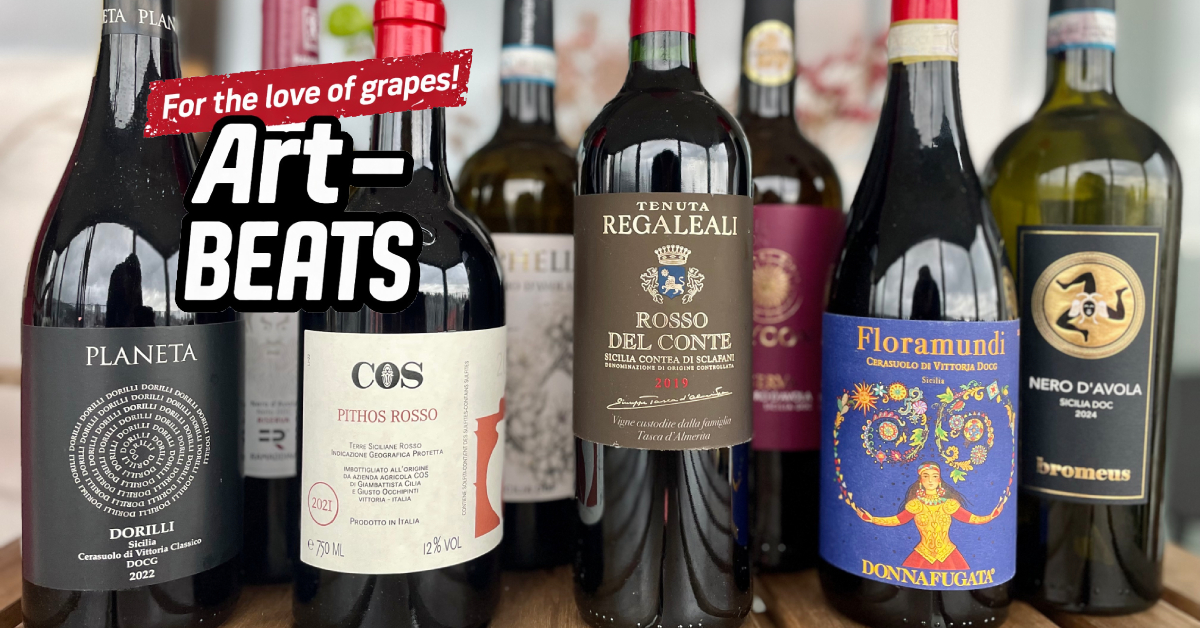
This is where Art-Beats’ wine writing begins. As a certified wine lover, my efforts to continuously educate myself will not seize, and it is an opportunity to combine tasting with the history and cultural significance of Sicily’s princely grape, Nero d’Avola.
I have found, that many wine guides often describe Nero d’Avola in a one-dimensional way, while I have come across styles of the wine that vary greatly. I have also encountered some prejudice towards the grape, that seem different from my own tasting experiences. So, this is my attempt to understand this wine grape better, and in a way that would also benefit others. After all, wine is a shared experience, isn’t it?

Why This Particular Grape?
The inspiration came came a little bit out of nowhere. I was browsing a local supermarket with my partner, who hadn’t shown interest in wine throughout her pregnancy. Suddenly she joined me in the wine section and, to my surprise, reached for a Nero d’Avola. That was just what she felt like. You can imagine I was thrilled to have my tasting partner back!
Over the past few years, I have built a small wine library while studying for the WSET, or collecting samples from my wine trips. Yet somehow, I’ve sort of overlooked Sicily’s flagship grape. The wine we chose seemed typical for Nero d’Avola: reasonably priced, bold and fruit-forward. Labelled with appellation Sicilia DOC from 2022, a ’Riserva’ (indicating at least some barrel-aging), and from Menfi in Western Sicily. The wine appeared with dark purple colour, well-balanced acidity and alcohol, present tannins, dark fruit-driven, like blackberry and black cherry, with hints of violet, vanilla, and liquorice. Altogether a nice tasty wine. Interesting enough to analyse, approachable enough to simply enjoy.
This made me think: for the price, is this an underrated grape? I couldn’t recall ever encountering anything else than affordable Nero d’Avola wines. What’s the story behind this grape?
Three Facts About Nero d’Avola
The Name and Greek Origin: Though considered indigenous to Sicily, evidence suggests Greeks brought the grape over 2,000 years ago when settling in Southeastern Sicily. “Nero d’Avola” translates to “Black of Avola” referring to the grape’s dark skin and the town of Avola. In the 18th century, merchants misleadingly marketed it as “Calabrese” since nearby Calabria held more prestige in the French market. However, “Calabrese” may derive from the Sicilian dialect “Calavrisi” (meaning from Avola) or the Greek “kali vrisi” (good grape or good spring). These explanations underscore the grape’s ancient cultivation and possible Greek linkage.
A Heat-Resistant Grape for the Future? Nero d’Avola thrives in Sicily’s Mediterranean climate, with very hot, dry summers averaging 30-35°C. The grape tolerates extreme heat where other varieties fail while retaining its wine character. This resilience has attracted attention from regions worldwide feeling the impacts of global warming, including South Africa, the US, and Australia.
Renaissance and Saviour: Beyond climate adaptation, Nero d’Avola served as a workhorse during the 19th-century phylloxera crisis, which destroyed two-thirds of European vines. Its intense colour and high alcohol played a significant supporting role in helping the paler Northern Italian and French wines at the time, who were suffering from the crisis and was dubbed “le vin médecine” (medicine wine). It later transformation from humble blending grape to signature varietal began in earnest in the 1980s through the efforts of pioneering Sicilian winemakers.

The Pioneers Who Changed Sicilian Wine
To understand Sicilian wine today, we must look at the pioneers in the 1980s and 1990s. Through their refined approach to Nero d’Avola, they transformed the quality and reputation of Sicilian wine, establishing it as a distinguished single varietal with a distinct expression.
Giuseppe Tasca d’Almerita (Tasca d’Almerita): Perhaps the earliest pioneer, beginning his quality revolution in the 1970s at the family’s historic Regaleali estate. He was one of the first to recognise Nero d’Avola’s potential for producing age-worthy, complex wines when yields were reduced and vinification carefully controlled.
Flagship wine: Rosso del Conte (1970).
Franco Giacosa (Duca di Salaparuta): Revolutionised Sicilian winemaking in the 1980s by applying rigorous vineyard selection and blending Nero d’Avola with international varieties. He demonstrated that Sicilian wines could compete globally with elegance and structure, moving away from rustic, heavy styles. His approach to oak aging and emphasis on balance helped redefine what Nero d’Avola could achieve.
Flagship wine: Duca Enrico (1984).
Diego Planeta (Planeta): As president of Sicily’s Settesoli cooperative and founder of his family winery, Diego Planeta was the ‘architect’ of modern Sicilian wine. He conducted terroir research to understand soils and to figure out the right grape clones, introduced modern winemaking techniques like temperature-controlled fermentation and the use of barriques for ageing wine.
Flagship wine: Santa Cecilia (1997).

Giacomo Rallo (Donnafugata): Founded Donnafugata with his wife Gabriella Anca Rallo and pioneered terroir-driven Sicilian wines. He recognised that Nero d’Avola could produce wines of finesse and complexity when grown in the right locations and handled with care. His philosophy focused on respecting the grape’s character while employing modern techniques.
Flagship wine: Mille e Una Notte (1995).
COS (Giambattista Cilia, Giusto Occhipinti, Cirino Strano): Founded in 1980, this trio took a radically different approach, embracing natural winemaking, biodynamic viticulture, and ancient techniques like amphora fermentation. While other pioneers looked to modernisation, COS looked to the past, proving that Nero d’Avola could express profound terroir through minimal intervention.
Flagship wine: Pithos Rosso (2000).
The “Prince of Sicily” – Different Styles
Nero d’Avola has earned the nickname the “Prince of Sicily” through remarkable versatility. From powerful, oak-aged bold wines to elegant, terroir-driven expressions, this grape has demonstrated great versatility.
How to Identify the Style from the Label
Unlike some regions where appellations strictly dictate style, Sicilian Nero d’Avola might require a little detective work:
Appellation: Cerasuolo di Vittoria DOCG, is currently the only DOCG from the island (blended with other local grape Frappato) tends toward elegance and finesse, while sub-regions like Noto DOC can be full-bodied, as well as express leaner styles. Sicilia DOC hint a broad regional sourcing, and typically an approachable style of wine. Specific DOCs (like Noto, Etna, Eloro) are typically more terroir-focused, often of higher quality. The appellation level is more an indication of the strictness of requirements of the wine producers than a quality label, and is meant to set certain expectations of wines for consumers.
Single-estate vs. cooperative: Single-estate wines (look for “tenuta” or specific vineyard names) usually indicate more terroir-focused approaches, while cooperative bottlings may lean toward approachable, fruit-forward styles.
Alcohol level: Often, wines above 14% ABV signal riper fruit and fuller body, while 12.5-13.5% could suggest leaner and fresher wines, cooler sites or earlier harvesting for more freshness.
Blend or varietal: a DOC or IGT wine labelled ‘Nero d’Avola’ alone means at least 85% Nero d’Avola, where a smaller percentage can include Frappato or other varietals. IGT classifications often indicate blends with international varieties like Cabernet Sauvignon, Merlot, or Syrah/Shiraz.
“Riserva” might appear on the bottle indicating extended barrel aging (it does not indicate large or small oak, new or old barrels). But, one can expect softer tannins, and aromas such as vanilla, tobacco, smoke, or spice notes. Most often these are fuller body wine with some added complexity. It is a style choice rather than a quality label.

Soils and Their Impact on Flavour
Sicily’s geological diversity profoundly shapes Nero d’Avola’s character:
Limestone soils: Locally referred to as “Terre Bianche” meaning white earth. Notably around Noto and Elope (southeastern Sicily. Provide excellent drainage and moderate vigour, yielding wines with pronounced “minerality”, elegant structure, bright acidity, and refined tannins.
Clay soils: Notably Menfi and Sambuca di Sicilia. Retain moisture during hot summers, can produce fuller-bodied wines with riper fruit character, softer tannins, and generous texture—but sometimes less acidity.
Volcanic soils: Famously found around Mount Etna and parts of western Sicily. Contribute distinctive mineral complexity, smoky notes, and saline quality. The porous nature provides good drainage while adding depth to the wine’s profile.
This soil diversity means that Nero d’Avola from Noto tastes markedly different from wines grown in Contessa Entellina or near Etna’s foothills.
Main styles comparison to other wines
Nero d’Avola is a bit of a chameleon grape. It is known as a versatile grape that is good at expression different terroirs. However, I see many wine guides and sites describing it, and maybe a bit too general and simplified, as just a bold black fruit driven wine with power and high alcohol. In my experience, there is not one overall style of Nero d’Avola wine, so this description can perhaps confuse consumers.
The combination of soil, vineyard aspect, and winemakers’ choices (like harvest timing, blending, and ageing) ultimately determines the style of each example of wine, but I find, there are two main types that can be identified; the bolder and the lighter styles.
I would love to just say, in southeast Sicily they produce leaner and elegant red fruit-driven wines, and Central Sicily, they produce bolder black fruit-drive wine. But, it is not always that straight-forward.
Bolder Styles – this style is usually characterised by aromas of dark fruit (like blackberry, black cherry, plum), jam and liquorice, and with oak-ageing notes of chocolate, tobacco, and vanilla. These often have a higher alcohol content (14%+). The tannins are often more “structured” (meaning prominent and mouth-drying) and contributes to wines age-worthiness. These styles of Nero d’Avola are sometimes compared to Cabernet Sauvignon, Syrah/Shiraz, and Primitivo/Zinfandel.
Lighter Styles – this style is more characterised by fragrant aromas of red fruit (red cherry, raspberry, and strawberry), and dried herbs, but likely less oak ageing to preserve the freshness and fruit character. This style is likely to be less tannic, and can resemble a bolder style of Pinot Noir or leaner style of Grenache.
Super Sicilian Blends – additionally, to the styles above, many producers craft blends combining Nero d’Avola with international varieties. Nero d’Avola + Cabernet Sauvignon adds structure and aging potential. Nero d’Avola + Syrah creates exotic, spicy wines. These blends typically carry IGT designations, allowing creative freedom.
Premiumisation and Authenticity
The global wine market is experiencing a dual shift; producers moving toward quality over quantity (premiumisation), while consumers increasingly seek authentic, distinctive wines, and especially native grapes that tell a story of place.
Nero d’Avola embodies this perfectly. Once dismissed as rustic bulk wine, it has transformed into Sicily’s signature grape—a cultural ambassador representing the island’s sun, soil, and heritage. The global Nero d’Avola market was valued at approximately USD 1.43 billion in 2024, with steady growth projected through the 2030s, driven by rising wine tourism, growing interest in indigenous varietals, and increased organic production.
Nero d’Avola’s appeal lies in its authenticity and versatility due to its expressive fruit character, food-friendly nature, and often approachable pricing make it accessible to casual drinkers and enthusiasts alike. It now confidently stands alongside established European reds while maintaining its distinctive Mediterranean personality—proof that local identity and global recognition need not be mutually exclusive.
However, don’t judge by one bottle—try different sub-regions and styles to discover your preference and understand this versatile grape’s range. Cheers!
For further reading
- Nero d’Avola history and DOCs
- Tasca d’Almerita official site
- Donnafugata official site
- Big Hammer Wine – Why Nero D’Avola is More Delicious Than You Think
- Planeta official site
- COS official website
- Duca di Salaparuta official website
- Jancis Robinson article – Obituary and tribute to Diego Planeta
See also related articles: