
When I moved to Zurich back in 2022, I had never encountered Swiss wine. I soon discovered that not only do Swiss consumers thoroughly enjoy wine, but there is a worthwhile local production waiting to be explored. Of course, being surrounded by wine producing neighbours like Italy, France, Germany, and Austria, it’s not that strange to find wine production in Switzerland. So, my curiosity was instantly piqued. How come I had never seen Swiss wine abroad? What makes up the Swiss wine market, and what drives Swiss wine making these days?
I wanted to learn more about Swiss wine, since it seems to escape the curriculum of many wine courses, and it’s not really talked about outside of Switzerland, which makes it a little bit mysterious, but intriguing. It seems like, the only way to study Swiss wine, is from within the country, which puts me in a great position as I’m currently residing in Zurich.
The Six Swiss Wine Regions
Let’s get an overview. Switzerland has six main wine regions; Valais, Vaud, Geneva, Three Lakes, German-speaking Switzerland, and Ticino. There are few other smaller wine producing sub-regions, but I will focus on the six.

A little fun fact, Valais is the home region of the Europe’s highest located vineyard in the village of Visperterminen, as well as the world’s smallest, in Saillon, which consists of just three vines and has been owned by the Dalai Lama since 1999. I’ll ask him for a sample next time I see him.
Switzerland has around 2,500 winegrowers who cultivate 14,569 hectares of vineyards. That’s similar in production size to Slovenia, Baden in Germany, or Alsace in France. Valais is the largest wine region with approximately 4,600ha and has around 370 wine producers. Neighbouring region Vaud, is known for its UNESCO World Site listed sub-region, Lavaux, and its steep terraced vineyards along northern coast of Lake Geneva. German-speaking Switzerland basically stretches from central to Eastern Switzerland, where around 800 wine producers cultivate 2,600ha of planted vineyards.

In terms of appellations, Switzerland has over 60 AOCs (Appellations d’Origine Contrôlée), which ensures the wine, under strict regulation, comes from the stated place of origin, and expresses the regional typicity of geography and wine making know-how. The AOC Grand Cru appellation is not used in all six regions, and does apply extra strict criteria for vine yield and which grape varieties are allowed. It’s a little technical to understand the differences as it varies from region to region, and I personally look more at the producer or particular grape varieties.
It’s interesting to see that Valais has almost twice as many hectares of vineyards planted than German-speaking Switzerland, but only half the amount of wine producers. It could indicate more homogeneity in Valais, which is enforced by having an AOC Grand Cru appellation, while the German-speaking region looks like a more diverse region with many more smaller producers.
The Top Wine Grapes Produced

What makes Switzerland special, is not only its multilingual and cultural mash, and having easy access to key wine market nearby, but it’s local production and indigenous grapes. Similar to other European wine countries, different regions nationally also sort of specialises in certain grape varieties.
Currently, around 250 grape varietals are being produced where the most produced varietals lists Pinot Noir, Chasselas, Gamay and Merlot make up around 66%. The grape varietals can be distinguished in three categories; imported grape varieties, indigenous grape varieties, and created grape varieties.

Pinot Noir, as an imported grape variety, is by far the most produced wine grape. 25% (3,649 ha out of 14,569 ha) of planted vineyards produce Pinot Noir, with German-speaking Switzerland and Valais making up the largest share. Globally, it is one of the most planted varieties, and has been cultivated in Switzerland since the 15th century, which is not odd, considering its origin from around Burgundy, neighbouring Western Switzerland. It is known as a hard grape to grow, and is often seen as the ultimate challenge for winemakers. There is a certain prestige in creating a good wine out of Pinot. It has thin skin and buds early, which makes it sensitive to spring frost. It is often used for single-varietal lighter red wines, and is know to be excellent at expressing the terroir (a combined term for local climate, soil composition, winemaking know-how, and vineyard aspect)under which is was produced. However, it is also used for producing rosé and sparkling wines, so it’s really a multi-functional wine grape.
More specific to Switzerland, is the second most grown grape, Chasselas (sometimes called Fendant). It is a white indigenous grape variety, and makes up around 24% (3,444 ha out of 14,569 ha) of planted vineyards. It is mainly grown in Western Swiss regions of Vaud, Valais, Three Lakes, and Geneva, and benefits from cool climate and chalky soils. It is often used as an aperitif wine with cheese or snacks, or maybe more famously, paired with Swiss cheese fondue or raclette dishes. It is often light, acidic and fruity, which goes well with fattier foods like cheese or white fish. In my personal encounters of Chasselas, there is no risk of this white wine overpowering the food. Some noteworthy examples of esteemed Chasselas-producing villages includes the UNESCO-listed Lavaux sites in Saint Saphorin and Dézaley, Féchy in La Côte, as well as Yvorne in Chablais.
Ticino is Merlot. Of course you can find Merlot across Switzerland, and you can find other varieties in Ticino, but it’s dominated by Merlot vineyards, by far. Merlot is one of the world’s most produced grape variety, and is perhaps most known as a blending grape in Bordeaux wines or Supertuscan blends where it contributes to softening the body of wines using higher tannin grapes, while adding fresh cherry and plum notes. It can reach high alcohol levels in more moderate climates, and medium alcohol in cooler climates, so it is a pretty versatile grape that is considered easy to grow.
In Switzerland, Merlot might be more comparable to the single-variety styles in Friuli, Northern Italy. Ticino Merlots can vary in style from medium to fuller body, and often oak-aged. Interestingly, Ticino also produces Bianco di Merlot (white Merlot), which still uses the red grape, but the vinification process (the winemaking process after harvesting) produce wine as if it was a white wine, meaning no grape skin contact, soft pressing, controlled temperatures during fermentation, there might be ageing “on the lees” (meaning kept in contact with leftover yeast after fermention), and perhaps no or less oak-ageing. These often produces complex and fragrant white wines, and can give vibes of white Burgundy wines. Whether red or white, the Ticino Merlots are a great place to start when diving into Swiss wines.
The Indigenous Wine Grapes

This area of wine production is always super interesting to me, the native or indigenous grapes. These grape varieties are unique to a specific location of origin, and are often less recognised outside the country or region of origin. Some of these grape varieties might have been introduced at one point in time, often neighbouring countries, but after centuries of cultivation or playing an important in local wine traditions, they can be considered indigenous.
Out of Switzerland’s around 250 grape varieties produced, 40 are considered native to the country.
Chasselas, has already been mentioned as the most planted indigenous grape variety, and other important indigenous grape varieties include the white grape Petite Arvine, mostly found in Valais. In recent years it has garnered great praise and awards in international wine competitions. Typical aromas include grapefruit and rhubarb notes, sometime salinity and zesty acidity.
Similarly, there are red grape varieties like Cornalin and Humagne Rouge. These are considered somewhat rare, but they are not that hard to find in Swiss wine stores.
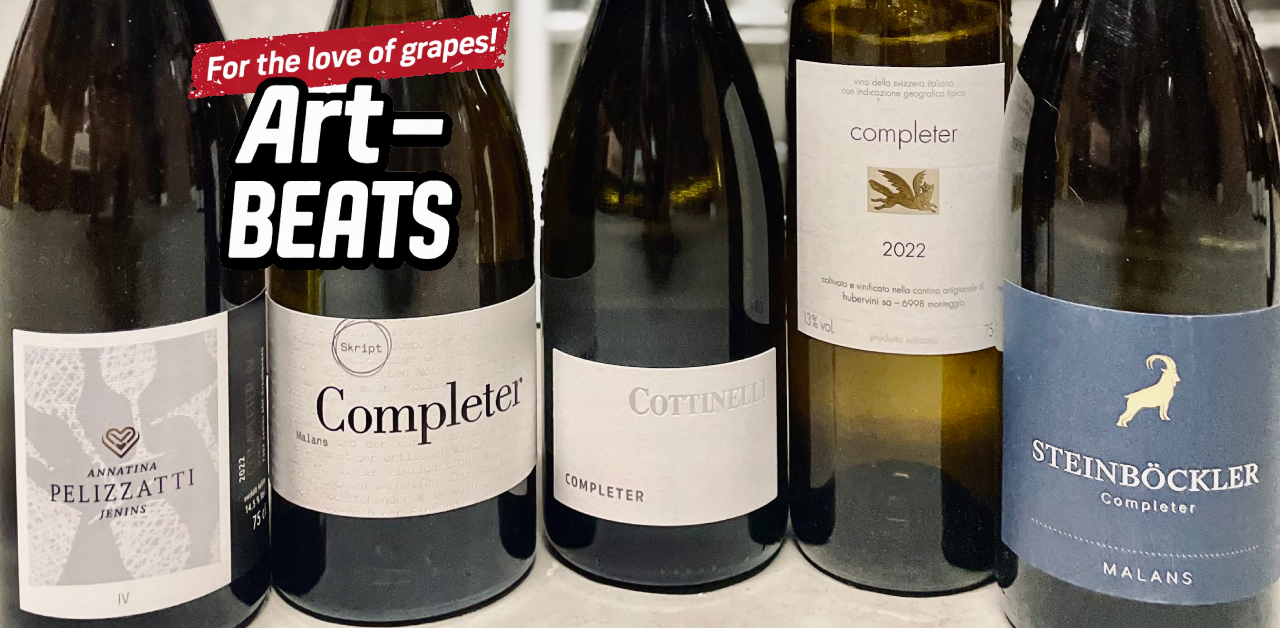
I want to dedicate some space for an indigenous Swiss white wine variety that has really blown me away. Completer, to me, is probably the best kept secret the country has to offer. There are only around 10 hectares of this variety planted, making it a very rare grape mostly grown in the Graubünden (Grisons) in Eastern Switzerland, but there a some examples in Ticino, Zurich and Valais that I’ve come across. It is hard to find, it is often expensive, and the worst part it, it is absolutely delicious!
Apparently, this variety was first mentioned in records dating back to 1321, where Benedictine monks in the town of Chur drank this wine after the evening prayer (or “Completorium”, hence the name), making it one of the oldest known grape varieties in Switzerland. It’s a full-bodied aromatic wine, it has high acidity and often tropical fruit aromas like pineapple. Personally, this is my personal favourite Swiss wine grape, and has plenty of star quality.
I had the pleasure of trying a menu of three Graubünden traditional dishes Capuns (dumplings wrapped in spinach leaves simmered in milk), Maluns (potato bits with apple sauce), and Pizokel (buckwheat pasta dish), with a glass (or two) of Completer. Brilliant!

Another grape variety worth mentioning, is the Räuschling, mostly found around Zurich. It also have a long history of cultivation, with earliest records dating back to 1546. Similar to Completer, it holds high acidity, but unlike Completer, it’s a light and citrussy white wine. It ages well, and can resemble Riesling over time.
Wine Trends in Switzerland
I sometimes get the impression that Swiss wine is perhaps a little misunderstood, perhaps more among visitors and expats living in Switzerland, since Swiss wine is not really accessible outside the country. Switzerland is a cool-climate country, meaning, wines produced here will naturally have good acidity, leanness, and freshness. If you are unfamiliar with the general lightness of for example Pinot Noir or highly acidic white wines often produced in cool-climate countries, you might be missing out on the finesse and elegance, which I find synonymous with Swiss wine craft.
When looking at Swiss wine trends, you are really looking at domestic trends and consumption, and less about Swiss wine enjoyed on the international stage. In recent years, Switzerland has ranked 4th worldwide in terms of wine consumption per capita by consuming 29,7-31,8 litres per person per year (equivalent to 22-28 bottles), whereof around half the bottles were Swiss wine.
In relation to global consumption, this is still a pretty high consumption per capita. But, the consumption seem to have been decreasing year by year. In terms of sales, local support for Swiss wine is still great, and is even growing compared to imported wines. It has long been the case that about half the wines purchased by Swiss consumers are local wines, and more or less the whole production of wine is consumed locally, meaning there is not enough wine to satisfy the local consumption, so some import is necessary.
The topic has become politicised by Swiss wine associations, as concerns of cheap imported wines are squeezing out local wines. One of the concerns is that the cultural wine practices and know-how face existential threats. On the other hand, there seems to be two trends worth noting; people might be buying less wine, but they pay more per bottle, and German-speaking Switzerland seem to be doing pretty well, while Western Switzerland seem to be facing more difficulties.
But those statistics alone doesn’t paint a full picture. Globally, there is a decrease in wine consumption, which can partly be explained be health consciousness (like the WHO’s “no safe level” campaign), consumer habits such as premiumisation of wine (consumers buying less, but spending more per bottle), and other trends like the boom in alcohol-free wine and beverages. My sense is that the same patterns are emerging in the Swiss market as well.
Some Closing Thoughts

The production of the most planted grape, Pinot Noir, might seem overwhelming, considering stiff Pinot competition from Burgundy, US, New Zealand, German Baden, or Chile. But the climate is well suited for it, there is an interesting in producing this prestigious grape, and it’s a very versatile food pairing wine, as well as its usage in rosé and sparkling wine. So of course, Switzerland should continue to produce its Pinot, especially if the demand is there.
However, I personally find other grape varieties more interesting as Swiss products. The indigenous grape varieties like Petite Arvine, Räuschling and especially Completer (I’m aware I just named three white varieties), are not just interesting culturally, they are actually really delicious.
Indigenous grapes, are great components in local story telling, as well as place marketing. They add a certain “flavour” to places you visit, or they make you want to visit certain places. Considering Switzerland’s two neighbours Italy and France, the two biggest wine producers in the world, Switzerland is a great place for wine lovers. You can find wine from anywhere around the world almost anywhere in Switzerland, as well as a great selection of local wines. It’s amazing to have that access. And it’s a great way to learn about a country and region.
If Swiss wine has taught me anything, it’s that the most rewarding bottles are often the ones nobody told you to look for.
Cheers!
Further reading
- Jancis Robinson on planting density and yield
- Valais wine history and 1850 regulation change
- Valais specialtiy wine grapes
- Endangered Heritage Grape Varieties in the Vineyards of Valais
- Swiss drank less wine in 2023 – but more of it was local
- Swiss winegrowers in crisis
- The Vaud wine region
- Switzerland – a paradise for wine-lovers
- Chasselas – The king of vines
- Swiss wines perform well in competitions
- About the wine grape Completer
- The Grand Cru Confusion Explained
- AOCs in Vaud